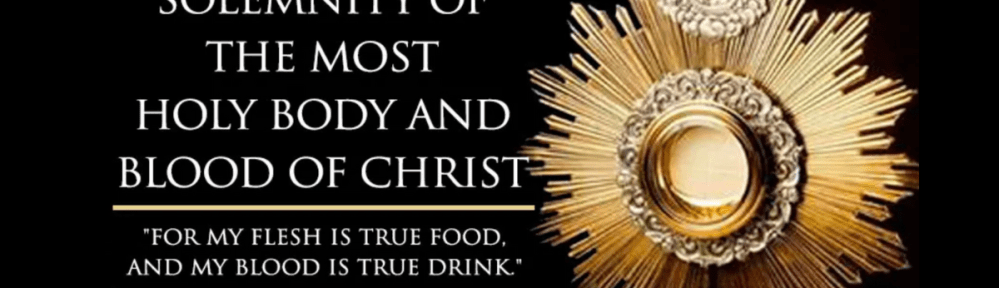
This coming Sunday is the Solemnity of the Body and Blood of Christ. With all that in mind (the previous posts) we come to the gospel passage for the feast.
51 I am the living bread that came down from heaven; whoever eats this bread will live forever; and the bread that I will give is my flesh for the life of the world.” 52 The Jews quarreled among themselves, saying, “How can this man give us (his) flesh to eat?” 53 Jesus said to them, “Amen, amen, I say to you, unless you eat the flesh of the Son of Man and drink his blood, you do not have life within you. 54 Whoever eats my flesh and drinks my blood has eternal life, and I will raise him on the last day. 55 For my flesh is true food, and my blood is true drink. 56 Whoever eats my flesh and drinks my blood remains in me and I in him. 57 Just as the living Father sent me and I have life because of the Father, so also the one who feeds on me will have life because of me. 58 This is the bread that came down from heaven. Unlike your ancestors who ate and still died, whoever eats this bread will live forever.”
But let’s place this in a larger perspective from the whole of the Discourse: He gave; bread from heaven; to eat. Let’s observe this happen.
- He gave (vv. 26–34). In this first section, the emphasis lies on the giving. Jesus will give (vv. 27, 34), not as Moses gave (v. 32) a perishable manna food of mortality, but as the Father, source of eternal life, gives (v. 32). Thus far, Jesus appears as the giver of bread and therefore as the new and superior Moses.
- bread from heaven (vv. 35–47). The insistence now shifts to the bread from heaven that Jesus not only gives but actually is (vv. 35, 38, 41, 42). It is important to note here that the operative verb is “believe.” Jesus as bread from heaven is accepted and consumed through the belief required in verses 35, 36, 40, 47. What this means is that this is a faith nourishment. Jesus is bread from heaven, feeding all believers, in the same sense that Old Testament wisdom nourished all who accepted it (Prov 9:1–5).
- to eat (vv. 48–59). In this final section, the vocabulary changes radically. The significant words are “flesh,” “blood,” “eat, ” “drink.” Note the constant repetition of “eat” (phagein) in vv.49, 50, 51, 52, 53, 54, 58. “Feed on” (trōgein – an even more physical verb in the Greek than “eat”) occurs in v.57. These verbs become overwhelmingly insistent, as does the constant reference to flesh and blood, food and drink. The meaning of the discourse has changed. Where in the preceding section Jesus nourished through wisdom-revelation those who believed, the verb “believe” has now completely disappeared and is replaced by “eat,” “feed on.” This is language which clearly speaks of sacramental nourishment, of the food and drink that one eats and feeds upon, of the Eucharistic nourishment provided by the flesh and blood of the Son of Man (v. 53). The “Son of Man” phraseology tells us that this is not the physical flesh and blood of the earthly Jesus and that we are asked to eat and drink but the spiritual, Spirit-filled flesh and blood of the heavenly Son of Man. Verse 58 ties the discourse together by referring back to the central phrase of verse 31.
What this discourse has done, therefore, is to deliver a rich and multi-faceted exposition of the Jesus-as-Bread-of-Life theme.
- Jesus is first of all the giver of the bread, a new Moses.
- He is also the bread of wisdom and revelation who nourishes all who come to him in faith.
- He is, finally, the Eucharistic source of eternal life for all who eat and drink the flesh and blood of the heavenly and glorified Son of Man.
Because John uses this Eucharistic material in this Bread of Life homily, it will not be too surprising — yet surprising enough — that the Eucharist will not be mentioned at the Last Supper. Its material has been transferred to this incident. John has also succeeded, with this transfer, to unite in this one chapter the essentials of Christian Eucharist, the word and the bread — the revealing word of vv.35–47 and the sacramental bread of vv.48–59.
Jesus gives his flesh to eat. The question that emerges from the dispute among “the Jews” is a rejection of Jesus’ outrageous suggestion: “How (ōs) can this man give us his flesh to eat?” (v. 52). But it allows Jesus to conclude his discourse on his perfection of the Mosaic gift of bread from heaven through his gift of himself as the true bread from heaven. Unable to go beyond the physical, “the Jews” by their question misunderstand Jesus’ promise. Jesus insists on a gift of flesh and blood for life by stating negatively (v.53) and positively (v.54) that whoever eats the flesh and drinks the blood of Jesus, the Son of Man, has eternal life now and will be raised up on the last day. The midrashic play on the verb “to eat” provided by the Exodus passage in v. 31 has reached its high point. “Flesh” and “blood” emphasize that it is the incarnate life and very real death of the Son that are life giving food. Only the physical body of a human being produces flesh and blood. The argument of vv. 25-51 continues into vv. 52-59, especially in Jesus’ words that point to the resolution of a series of promises (cf. vv. 12-13, 27, 35, 51c). Jesus will provide a food for the life of the world, and that food is his flesh and blood.
As the ancestors of Israel were nourished by the gift of the Torah, Jesus will nourish the whole world with the gift of himself.
The people of Israel were nourished by eating the manna, perennially recalled in the nourishment provided for them by their total receptivity to and absorption of the Law.
Now “the Jews” are told of the absolute need to eat the flesh and drink the blood of the Son of Man. Unless they eat the flesh and drink the blood (ean me phagete . . kai piete) of the Son of Man they have no life (v. 53); whoever eats the flesh and drinks the blood (ho treigōn . kai pinon) of Jesus has eternal life (v. 54).
The shift from the more respectable verb “to eat” (phagein) to another verb that indicates the physical crunching with the teeth (trōgein) accentuates that Jesus refers to a real experience of eating. Hints of the Eucharist continue to insinuate themselves into the words of Jesus. Flesh is to be broken and blood is to be spilled. Violence has been in the air since Jesus’ behavior on the Sabbath led “the Jews” to initiate a process that would lead to his death (5:16-18).
Discover more from friarmusings
Subscribe to get the latest posts sent to your email.
 friarmusings