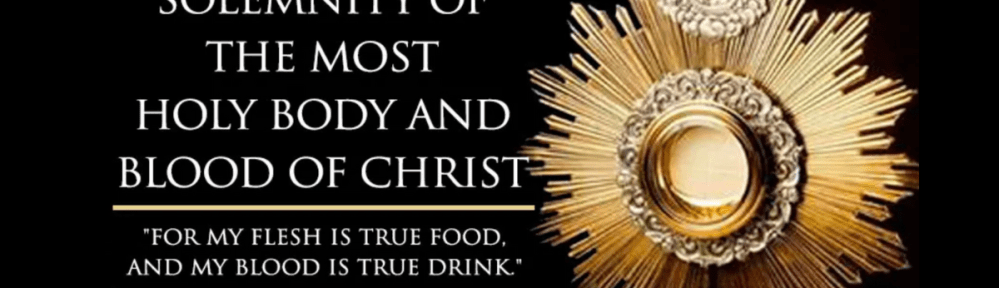
This coming Sunday is the Solemnity of the Body and Blood of Christ. Where the principal focus of the previous section is the bread of life as the divine revelation given to men by and in Jesus, Jn 6:51 moves the focus to a clearly Eucharistic theme – ‘I am the living bread come down from heaven; whoever eats this bread will live forever; and the bread that I will give is my flesh for the life of the world.‘ While some argue the words are metaphor, the Jews clearly understand. Jesus is referring to eating of his flesh.
He recounts this action verb several other times between vv. 51-58, while adding the drinking of his blood to the command. This is no metaphor for accepting his revelation, already adequately expressed. “To eat someone’s flesh” appears in the Bible as a metaphor for hostile action (Ps 27:2, Zech 11:9). In fact, in the Aramaic tradition, the “eater of flesh” is the title of the devil. The drinking of blood was looked upon as a horrendous thing forbidden by God’s Law (Gen 9:4, Lev 3:17, Dt 12:23, and Acts 15:20). Its symbolic meaning was that of brutal slaughter (Jer 45:10). In Ezekiel’s vision of apocalyptic carnage (Ez 39:17), he invites the scavenging birds to come to the feast: ‘You shall have flesh to eat and blood to drink.’ Thus if Jesus’ words in v.53 (Jesus said to them, “Amen, amen, I say to you, unless you eat the flesh of the Son of Man and drink his blood, you do not have life within you.) are to have positive, favorable meaning, they refer to the Eucharist.
In v.51, we have a parallel with v.35, which is the beginning of the revelation form of the Bread of Life Discourse, except that in v.51 Jesus speaks of the “living bread”, a term more suitable for the Eucharist. In this same verse we see the connection of the living bread-the flesh-come down from heaven. Recalling Jn 1:14 where the entrance of the Word among us was spoken of in terms of becoming flesh; and it is this same flesh that is to be given to man as living bread. In the same passage John invokes the Incarnation and then closes with the death of Jesus, a Eucharistic theme. Where in v.32 it is the Father who gives the heavenly bread (revelation), in v.51 where the bread becomes identified with the flesh of Jesus, he must give it himself. Jesus must lay down his life of his own accord and that voluntary death makes Eucharistic participation in his flesh possible. At the beginning of the Gospel we hear that Jesus is the Lamb of God who takes away the world’s sins (Jn 1:29); now in context of a discourse set at Passover time we hear that Jesus becomes the Paschal lamb and gives his flesh for the life of the world.
In v.52 we see a misunderstanding that parallels vv. 41-42. Strangely, Jesus does not take any pains to explain away the Jewish repugnance at the cannibalistic thought of eating his flesh; rather in v.53 he emphasizes the reality of “feeding” on his flesh and adds the even more repugnant note of drinking his blood. Versus 55-56 promises the gift of life to one who feeds on this Eucharist, but the Eucharistic promise follows the main body of the Discourse (vv 35-50) which insists on the necessity of belief in Jesus. The juxtaposition of the two forms of the discourse teaches that the gift of life comes through belief in Jesus. The Eucharistic life-giving is not through the “feeding”. Jn 6:57 says ‘..the one who feeds on me will have life because of me [Jesus]’.
The two themes of the Discourse, faith and Eucharist, cannot be separated for neither faith nor the Eucharist are directly the focus of attention, but rather both are unified in the person of Jesus who offers a living relationship through faith and Eucharist. The sacramental experience does not replace faith in Jesus, but expresses and confirms it. For John Eucharistic faith is to believe that the same, risen, Incarnate Jesus continues to give himself to believers in a personal communion and to exercise his life-giving mission. Whoever participates in the exercise of faith and Eucharist ‘remains in me and I in him’.
While the synoptic gospel writers record the institution of the Eucharist, the theological gospel writer is the one who explains what the Eucharist does for the Christian – the personal communion with Jesus and thus with the Father.
Discover more from friarmusings
Subscribe to get the latest posts sent to your email.
 friarmusings