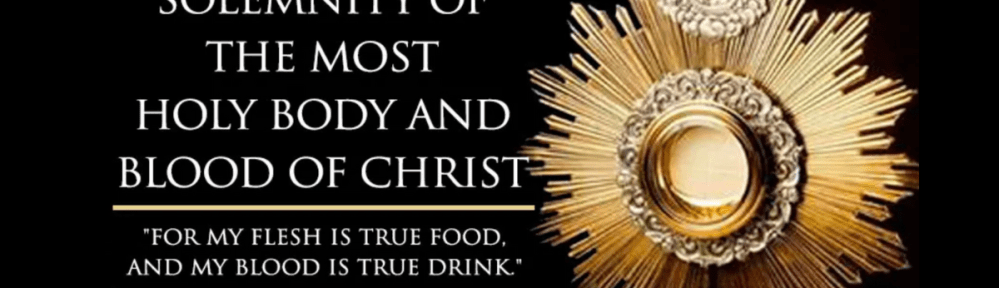
This coming Sunday is the Solemnity of the Body and Blood of Christ. In Jn 6:60, some of the disciples of Jesus react negatively saying ‘This saying is hard; who can accept it.’ Are they referring just to the immediately preceding passages (vv. 51-59) or are they referring to all of Jesus’ claim in v.42, ‘I have come down from heaven.’? Jesus’ own words give us the context, “Do you take offense at this? Then what if you were to see the Son of man ascending where he was before?” That a man from Nazareth should claim that he is a life-giving revealer sent down from God, from heaven, is “hard” to take and only faith can overcome the “offense” or stumbling-block of the Incarnation. But if his words are too hard to take, then a worse shock awaits them when they see him raised on the cross and then it will be a real test of their faith to believe in his death and resurrection.
In v.63 Jesus’ words provide another stumbling block – “It is the spirit that gives life, the flesh is of no avail…” Many non-Catholic interpreters believe that this line removes the basis for belief in the Real Presence in the Eucharist. But St John has already provided us the context for interpreting Jesus’ remarks. In Jn 3:6-13, Nicodemus can not understand how a man can be born from above. By way of explanation, Jesus calls upon the ascension into heaven of the Son of Man; for it is the ascended Son of Man who can give the Spirit. So also in Jn 6:63, the Spirit is mentioned immediately after the reference to the ascension of the Son of Man. The contrast between Spirit and flesh in v.63 is the same contrast found in Jn 3:6. Jesus is not speaking of Eucharistic flesh but of flesh as he spoke of it in Jn 3:6. There, the natural principle in man, which can not give eternal life, is useless. The Spirit is the divine principal from above which alone can give life. In v.63 Jesus once more affirms that man cannot gain life on his own. Jesus’ role is to communicate to man the principles of eternal life so that those who believe in Jesus receive the life-giving Spirit.
In a sense the non-Catholic interpreters are correct in what they affirm, but they are wrong in what they deny. The Eucharist is of no avail to the non-believer who has not been blessed by the Spirit to believe the mystery of the Eucharist. It is only through faith in the resurrected Jesus that the Holy Eucharist has meaning.
A Final Thought – There are many commentaries that insist on a metaphorical interpretation of “eat” and “drink” and are thus unable/unwilling to move beyond “eat” and “drink” as metaphors for belief. There are some commentators who insist there is no metaphor, that the entirety of Jesus’ discourse is sacramental/Eucharistic. As Fr. Raymond Brown and Fr. Francis Moloney point out, the truly Catholic position is “both-and.” What begins in John 6:22-50 as metaphor for belief, is ultimately answered in John 6:51-58 as Eucharist.
Discover more from friarmusings
Subscribe to get the latest posts sent to your email.
 friarmusings