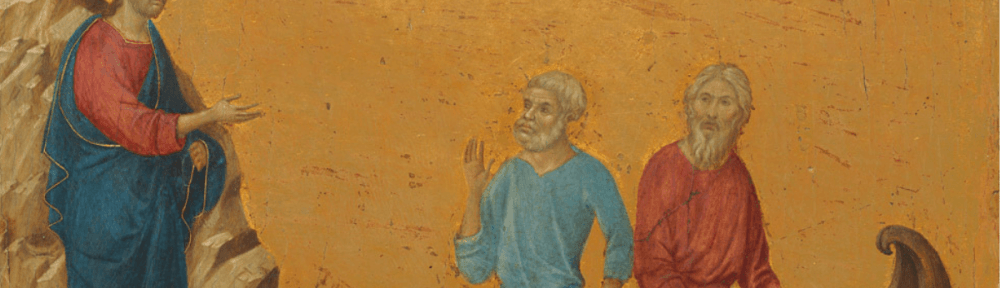
This Sunday is the 11th Sunday of Ordinary Time. The gospel is from the opening verses of the Matthean Missionary Discourse. From the first verses one should notice a change in vocabulary as Jesus “summoned his twelve disciples and gave them authority over unclean spirits to drive them out and to cure every disease and every illness. The names of the twelve apostles…” (Mt 10:1-2) Up until this point those who follow Jesus have been referred to as “disciples.”
The term “disciple” generally refers to a follower or student of a teacher. In the context of the Gospel of Matthew, it primarily refers to those who followed Jesus during his earthly ministry, learning from his teachings and observing his actions. The disciples were individuals who chose to follow Jesus, committing themselves to his teachings and the way of life he exemplified. They were his close companions, accompanying him on his journeys, witnessing his miracles, and receiving personal instruction from him.
The term “apostle” specifically refers to a subset of disciples who were appointed by Jesus for a specific mission. The word apostle comes from the Greek word apostolos, which means “one who is sent out.” In Matthew’s Gospel, Jesus chooses twelve of his disciples and designates them as apostles. The names of the twelve apostles are listed: Simon (Peter), Andrew, James and John (the sons of Zebedee), Philip, Bartholomew, Thomas, Matthew, James (son of Alphaeus), Thaddaeus, Simon the Zealot, and Judas Iscariot (who later betrayed Jesus). While all apostles were disciples, not all disciples were apostles. The apostles had a unique commission to continue the work of Jesus after his departure, spreading the good news, establishing the church, and teaching others to observe all that Jesus had commanded them (Matthew 28:19-20).
This is the only time Matthew uses the word “apostle.” In the remainder of the gospel they are indicated by context or are referred to as “the Twelve.” R.T. France [2007, 375] notes: “It is surprising that Matthew does not use again what must have been, by the time he wrote his gospel, a familiar title for this inner group, but perhaps this indicates his awareness of a difference in function between the ‘apostles’ as church leaders in his day and the role of the Twelve as companions of Jesus during his ministry.”
Note that this is not an account of their “calling” as a group of 12. As individuals they had already been called, but even here they seem to be an already established group as they are “summoned.” The Gospels of Mark and Luke also list the apostles. With the exception of Thaddeus, the names are the same in all these lists, though the order of the names and the descriptions of the individuals vary a little. Scholars have noted that Matthew’s list has two distinctive features: it is arranged in pairs (perhaps reflecting the tradition that they were sent out in pairs and Simon (Peter), who comes first in all the lists and whose leading role among the twelve is clear in all the gospels, is explicitly designated in Matthew as “first,” even though no further numbering follows for the remainder of the names.
France [2007, 376] notes:
Jesus’ choice of twelve as the number of his inner circle has, and must surely have had at the time, obvious symbolic importance as the number of the sons of Jacob and thus of the tribes of Israel. People might have remembered Moses’ choice of twelve tribal leaders in Num 1:1–16, and it is even possible that Matthew’s phrase “These are the names of …” is a deliberate echo of Num 1:4, “These are the names of the men who shall assist you.” The symbolism will become explicit in 19:28, where these twelve disciples are given an eschatological role when, alongside the Son of Man seated on his own glorious throne, they too “will sit on twelve thrones judging the twelve tribes of Israel.” There is no reason to believe that these twelve Galilean men were in fact drawn from all twelve traditional tribes; their significance was in their number, not in their ancestry. When one of the Twelve was lost (note the emphatic “the eleven disciples” in 28:16, after Judas’ death), the number was sufficiently important for him to need to be replaced (Acts 1:15–26), though even before that Paul continues to refer to them as “the Twelve” (1 Cor 15:5). So from an early point in his ministry Jesus was apparently thinking in terms of an alternative “Israel” with its own leadership based now not on tribal origin but on the Messiah’s call.
Image credit: Duccio di Buoninsegna, 1308-1311, National Gallery of Art, Public Domain
Discover more from friarmusings
Subscribe to get the latest posts sent to your email.
 friarmusings