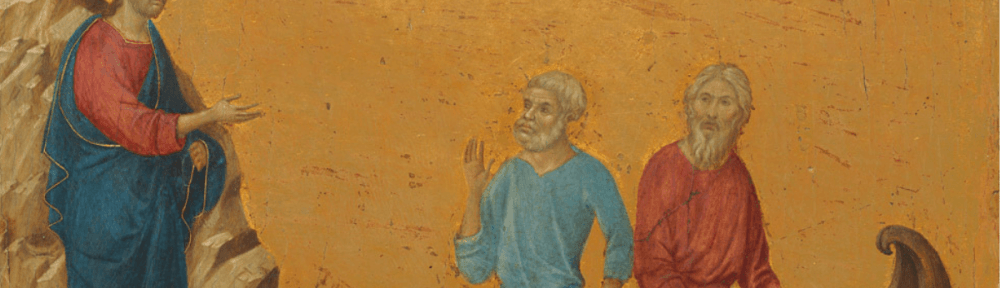
This Sunday is the 11th Sunday of Ordinary Time. The gospel is from the opening verses of the Matthean Missionary Discourse. In the previous post we discussed the summoning and significance of the 12 disciples called “apostles” (this one and only time in Matthew) and later called “the Twelve.” In this post The commission of the Twelve is spelled out in strictly functional terms as an extension of Jesus’ mission described in Mt 8 and 9. Note that the commission and its terms are also found in in Mark 6:7–11; Luke 9:1–5; 10:1–12.
5 Jesus sent out these twelve after instructing them thus, “Do not go into pagan territory or enter a Samaritan town. 6 Go rather to the lost sheep of the house of Israel. 7 As you go, make this proclamation: ‘The kingdom of heaven is at hand.’ 8 Cure the sick, raise the dead, cleanse lepers, drive out demons. Without cost you have received; without cost you are to give.
The text of the commissioning covers three aspects of their mission: to whom they are to go (vv. 5–6); the nature of their mission in both word and deed (vv. 7–8); and although not part of our gospel the natural boundaries of Matthew’s pericope (a set of verses that forms one coherent unit or thought) extend to v.15 and includes the familiar:
Do not take gold or silver or copper for your belts; no sack for the journey, or a second tunic, or sandals, or walking stick. The laborer deserves his keep. Whatever town or village you enter, look for a worthy person in it, and stay there until you leave. As you enter a house, wish it peace. If the house is worthy, let your peace come upon it; if not, let your peace return to you. Whoever will not receive you or listen to your words—go outside that house or town and shake the dust from your feet. Amen, I say to you, it will be more tolerable for the land of Sodom and Gomorrah on the day of judgment than for that town. (Matthew 10:9–15)
Many people note that the commission is given with geographical boundaries established: “Do not go into pagan territory or enter a Samaritan town. Go rather to the lost sheep of the house of Israel.” How does this make sense in the final mission statement in Mt 28:19, “Go therefore and make disciples of all nations”? There is an argument to be made that Jesus’ mission and the commissioning of the Twelve was to engage the God’s people Israel to be the light to all the nations – the work for which they were commissioned. By Mt 28, Jesus has been firmly rejected as Messiah, but the larger mission of drawing in all the nations remains. In this God’s people Israel are replaced by the Twelve.
Image credit: Duccio di Buoninsegna, 1308-1311, National Gallery of Art, Public Domain
Discover more from friarmusings
Subscribe to get the latest posts sent to your email.
 friarmusings