This coming Sunday is the 16th Sunday in Ordinary Time. This parable is unique to Matthew and unlike the other evangelists who also tell a pericope of the “Sower and the Seed,” Matthew’s use and placement of this unique parable seems to serve as a reinforcement of the themes of on-going conversion “in the world” that place where anxiety and the lure of riches choke the word and it bears no fruit (Mt 13:22).
The passage opens: “He proposed another parable to them. “The kingdom of heaven may be likened to a man who sowed good seed in his field.” (13:24). What we translate as “proposed” is more literally translated from paratithēmi meaning “to set before.” While the word is sometimes used to mean presenting or teaching laws (in the Greek language OT, Septuagint LXX), it is more typically used in the LXX and NT for serving a meal. R.T. France [2007, 525] suggests that it might mean the more straightforward “propose” but given its use in a parable, the idea of “serving a meal” may be more appropriate in that the listener will not be “spoon fed.” If they want to garner the fuller, deeper meaning from the parable, they are going to have to “chew on it a while.”
The opening of the parable might lead some readers astray: “The kingdom of heaven may be likened to a man.” It is a standard means of comparison (cf. 7:24; 13:31, 33; 18:23; 22:2; 25:1; 11:16) and reflects a standard Jewish idiom for “It is this way with the kingdom.” In other words, the “way” is the entire parable, not simply a man who sowed good seed in his field (13:24). Yet the man is not unimportant in the story. Unlike the person in the “Sower and the Seed” who may be a worker, a farmer, a hired hand, or the land owner; here in this parable, the man who sowed good seed in his field is clearly the householder (v.27) who is the Master (v.27) and who has his enemy (v.25). The man’s authority suits him as an analogy for God. Both rabbis and Greek philosophers employ a householder as an analogy for God.
Given the agrarian character of much of ancient life, it should not surprise us that fields and harvests figure prominently as settings in parables. How the images are used is not standard but garner meaning from their use in context. In Matthew’s use, context is provided by the earlier parable’s use of the soil in vv.3-9 (The Sower and the Seed). In an apparent re-emphasizing of those earlier themes, it may be that the land represents the “soil” of the people of God for whom Jesus came to bring salvation. In other words, the kingdom of heaven.
Two key figures in the parable are the enemy and the weeds. The weeds are probably darnel, a poisonous plant related to wheat and virtually indistinguishable from it until the ears form. To sow darnel among wheat as an act of revenge was punishable in Roman law, which suggests that the parable depicts a real-life situation. Who would do such a thing? Only an enemy or rival.
With early signs of the infestation, it was perhaps possible to uproot the weeds before their roots were entangled with those of the wheat – something the servants seem willing to propose (v.28). A light infestation of darnel could be tackled by careful weeding, but mistakes would easily be made (v.29). In the case of a heavy infestation the stronger roots of the darnel would be tangled with those of the wheat, making selective weeding impossible.
After the wheat and darnel were grown, they were easily distinguished and reapers could gather the darnel, which did have one use: given the scarcity of fuel, it would be burned.
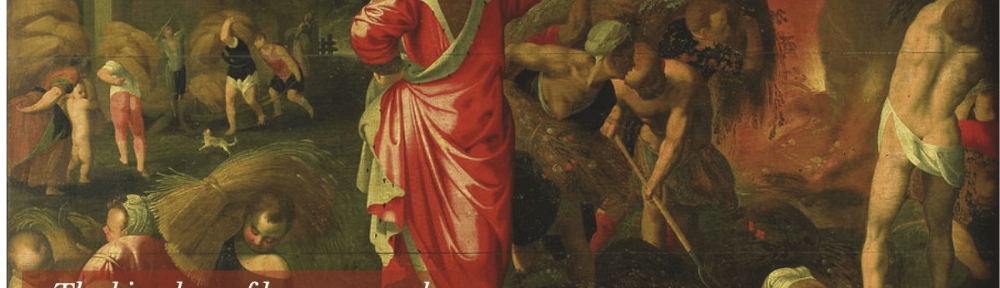
Image credit: Parable of the Weeds among the Wheat, attributed to Isaac Claesz. van Swanenburg, 1590 – 1610, Public Domain
Discover more from friarmusings
Subscribe to get the latest posts sent to your email.
 friarmusings