This coming Sunday is the 17th Sunday in Ordinary Time. The opening description in 13:3 and the concluding transitional comment at 13:53 indicate that Matthew considers everything in between to be parables, including v. 52. Thus, although commentators have liked to find exactly seven parables in the chapter, Matthew apparently considered the concluding picture of the scribe to be a parable as well, a parabolic concluding picture on the use of parables.
The picture comes as an elaboration of the disciples’ affirmative response to Jesus’ question. They claim to understand. These words added to Mark are to make clear that, for Matthew, understanding is not an optional element of discipleship.
Matthew understood that parables were constructed from a “treasure” of conventional metaphors, in which, for example, “king” or “father” customarily point to God, “harvest” or “accounting” to eschatological judgment, and such.’“ Both Jesus and Christian scribal teachers did this. The uniqueness of Jesus does not consist in the invention of radically new images, but in the surprising use to which they put the repertoire of familiar images. Vocabulary and style, as well as theology, indicate that
Matthew affirms both the old and the new (see 9:17). Like a skilled scribe, he brings out of his storehouse the treasures of his Jewish past (Scripture, stock of traditional imagery, perspectives, and concerns), as well as older Christian tradition (Mark). But he does not merely repeat the past. Alongside the old but introduces the new, presenting the old in a new light. Reclaiming it for the new situation in which he finds himself, seeing all things in the light of the Christ event and the coming of the kingdom. Even the unexpected order of “new and old” may be important: it is the new that provides the key to the appropriateness of the old, not vice versa.
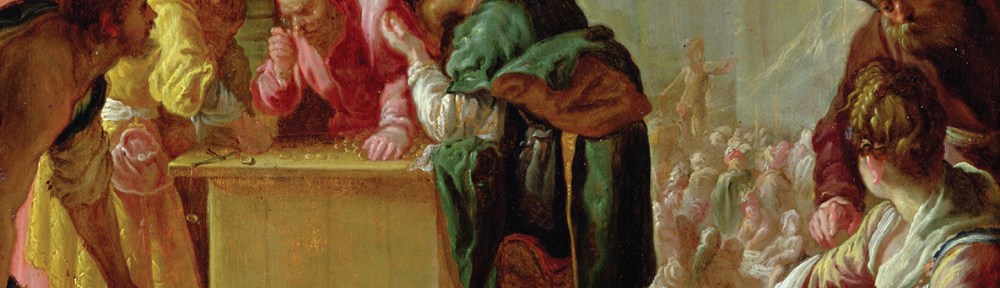
Image credit: The Pearl of Great Price, by Domenico Fetti, 17th century |Kunsthistorisches Museum Wien, Bilddatenbank | Public Domain
Discover more from friarmusings
Subscribe to get the latest posts sent to your email.
 friarmusings