I like science and I like science fiction. So, it is always interesting when Sci-Fi uses advanced concepts of physics to animate the plots of the television shows or movies. There are several episodes of various Star Trek series that have referred to or explored the concept of quantum entanglement. Here are a few instances where quantum entanglement is mentioned or featured in Star Trek – of course I haven’t explained quantum entanglement, but maybe the way the term is used might give you insight:
Star Trek: The Next Generation – “Schisms” (Season 6, Episode 5): In this episode, the crew of the USS Enterprise experiences strange disruptions in their sleep patterns and memories. It is eventually discovered that an alien species is using a form of quantum entanglement to abduct crew members and study them in an alternate phase of reality.
Star Trek: Voyager – “Coda” (Season 3, Episode 15): In this episode, the character Captain Janeway experiences a series of events that seem to loop in time. She discovers that she is trapped in a kind of quantum entanglement with an alien being that is attempting to feed off her experiences.
Star Trek: Voyager – “Scientific Method” (Season 4, Episode 7): In this episode, the crew of the USS Voyager is subjected to various experiments conducted by an unseen alien race. The aliens use a form of advanced technology that could be likened to quantum entanglement to observe and manipulate the crew.
The writers probably were using “quantum entanglement” as a buzz word and it is hard to see how the underlying science actually plays a part in the episode, but, hey! It’s entertainment!
Ok, that is television. But in the real world you may have heard about “quantum computing.” Instead of the standard “bits” (values of 1 or 0) used in standard computers, quantum computers use “qubits” which can be both 0 and 1 at the same time because of something called superpositioning. And qubits can become entangled with each other. But we are getting ahead of the story. What is “quantum entanglement?”
In 1935 Albert Einstein, along with colleagues Boris Podolsky and Nathan Rosen, proposed a thought experiment in 1935 that became known as the “EPR paradox” (Einstein-Podolsky-Rosen paradox). In this thought experiment, they highlighted what they saw as a potential problem with the way quantum mechanics described reality.
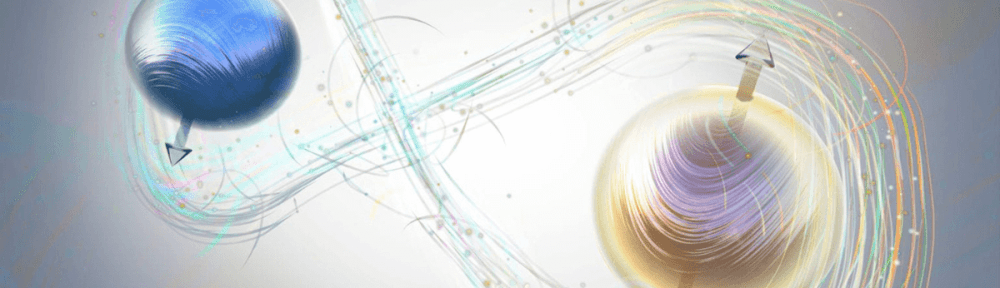
In the EPR paradox, the researchers considered a scenario involving two subatomic particles that are entangled. Entanglement is a quantum phenomenon where the properties of two particles become interconnected in such a way that the state of one particle is instantaneously related to the state of the other, regardless of the distance between them – even when the particles are on other sides of the galaxy. This seemed to imply that information about the state of one particle could be transmitted instantaneously, which appeared to contradict Einstein’s theory of relativity, which stated that nothing could travel faster than the speed of light.
Their thought experiment aimed to show that either quantum mechanics was incomplete, they were missing some hidden variables that could explain the entanglement, or that there was a fundamental flaw in the theory. They questioned whether the principles of quantum mechanics, which allowed for instantaneous correlations between distant particles, were consistent with the principles of causality and locality.
Einstein called this phenomenon “spooky action at a distance.”
In 1964, physicist John Bell formulated a theorem, known as Bell’s theorem, which showed that certain predictions of quantum mechanics could not be explained by any theory based on local hidden variables. Subsequent experiments testing Bell’s theorem and the EPR paradox have supported the predictions of quantum mechanics, demonstrating that entanglement does indeed lead to non-local correlations between particles. This phenomenon has been experimentally confirmed many times and is a central feature of quantum physics.
Quantum entanglement applications include developments in quantum computing, where entangled qubits can be used to perform certain types of calculations much more efficiently than classical bits. It also plays a crucial role in quantum cryptography, where entanglement can be used to establish secure communication channels that cannot be eavesdropped upon without detection.
Can it be used by Star Trek to instantaneously communicate across the Alpha Quadrant? Scientists believe that the answer is “no.” We’ll see. In the meantime, live long and prosper.
Image credit: Nicolle R. Fuller | National Science Foundation November 5, 2022 issue of Science News
Discover more from friarmusings
Subscribe to get the latest posts sent to your email.
 friarmusings