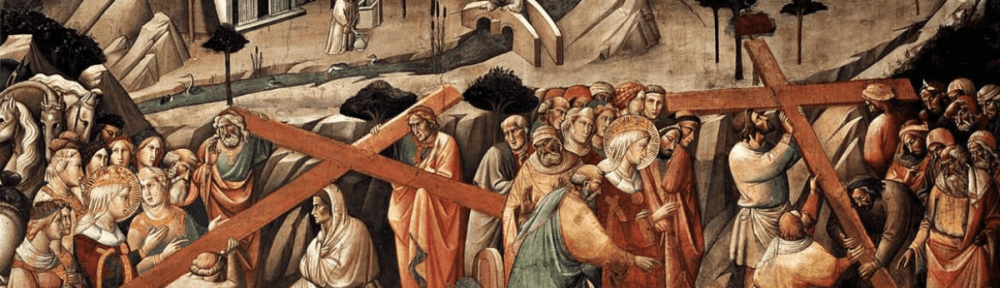
The Feast of the Exaltation of the Holy Cross, celebrated every year on 14 September, recalls three events: (1) the finding of the True Cross by Saint Helena, (2) the dedication of churches built by Emperor Constantine on the site of the Holy Sepulchre and Mount Calvary, and (3) the restoration of the True Cross to Jerusalem in AD 629 by the Byzantine emperor Heraclius, after it had fallen into the hands of the Persians in the AD 614 conquest of Jerusalem.
The feast of the Exaltation of the Holy Cross originated in the Church in Jerusalem. From the middle of the fourth century it was celebrated on 13 September, the anniversary of the dedication of the basilica erected on Golgotha under Constantine. According to the account written by a fourth-century pilgrim named Egeria, a relic of our Lord’s Cross had been found on that date a few years earlier. The “exaltation” or “raising up” of the Cross took place on the second day of the octave of the dedication, hence the date of celebration of September 14.
Emperor Constantine appointed his mother Helena the mission to locate the relics of the Christian tradition which she undertook in AD 326–28. According to Eusebius of Caesarea, who records the details of her pilgrimage to Palestine and other eastern provinces, and Socrates Scholasticus, she was responsible for the construction or beautification of the Church of the Nativity in Bethlehem, and the Church of Eleona on the Mount of Olives; sites of Christ’s birth and ascension, respectively.
After the 70 AD destruction of Jerusalem by the Roman armies, in 130 AD Emperor Hadrian built a temple to Venus over the supposed site of Jesus’ tomb near Calvary. According to Eusebius, “[t]here was a temple of Venus on the spot. This the queen (Helena) had destroyed.” According to tradition, Helena ordered the temple torn down and, according to the legend that arose at the end of the 4th century, chose a site to begin excavating, which led to the recovery of three different crosses. Around AD 327, Bishop Macarius of Jerusalem ordered the excavations in order to ascertain the location of Calvary as well as that of the Holy Sepulchre. It was in the course of these excavations that the wood of the cross was recovered.
According to the legend, Helena sought solid proof as to which of the three crosses was the Cross of Christ. Helena had a woman who was near death brought from the city. When the woman touched the first and second crosses, her condition did not change, but when she touched the third and final cross she suddenly recovered, and Helena declared the cross with which the woman had been touched to be the True Cross. On the site of discovery, Constantine ordered the building of the Church of the Holy Sepulchre. Subequently, pieces of the True Cross relic were distributed across the empire and by the turn of the 5th century were venerated as far away as Italy.
In the Roman liturgy the preface of the Mass reminds us that since the tree of Paradise was the place of mankind’s fall, God has wanted the Cross to be the new tree that would save us: “.. so that where death arose, life might again spring forth.” Jesus reminds all of us, ‘And when I am lifted up from the earth, I will draw everyone to myself.’ (Jn 12:32).
Reflection on the Feast by Pope Francis
The cross is a gibbet of death. Yet today we celebrate the exaltation of the cross of Christ, for on its wood Jesus took upon himself all our sin and the evil of our world, and vanquished them by his love. That is why we celebrate today’s Feast. The word of God that we have just heard tells us how, by contrasting serpents that bite with a serpent that saves. Let us reflect on these two images.
First, serpents that bite. These serpents attacked the people who had fallen once more into the sin of speaking against God. Such speaking against God was more than simply grumbling and complaining; on a deeper level, it was a sign that in their hearts the Israelites had lost their trust in him and his promises. As God’s people were making their way through the desert towards the promised land, they grew weary and could no longer endure the journey (cf. Num 21:4). They grew discouraged; they lost hope, and, at a certain point, they even seemed to forget the Lord’s promise. They lacked even the strength to believe that the Lord himself was guiding them towards a land of plenty.
It is no coincidence that, once the people no longer trusted in God, they were bitten by deadly serpents. We are reminded of the first serpent mentioned in the Bible, in the Book of Genesis: the tempter, who poisoned the hearts of Adam and Eve and made them doubt God. The devil, in the form of a serpent, tricked them and sowed seeds of distrust in them, convincing them that God is not good, and is even envious of their freedom and happiness. Now, in the desert, serpents reappear, this time as “fiery serpents” (v. 6). In other words, original sin returns: the Israelites doubt God; they do not trust him; they complain and they rebel against the one who gave them life, and so they meet their death. That is where distrustful hearts end up!
Dear brothers and sisters, this first part of the narrative asks us to examine closely those moments in our own personal and community lives when our trust in the Lord and one another has failed. How often have we grown dry, disheartened and impatient in our own personal deserts, and lost sight of our journey’s goal! Here too, in this vast country, there is a desert. For all its great natural beauty, it can also remind us of the weariness and aridity that we at times bear in our hearts. Moments of fatigue and trial, when we no longer have the strength to look up towards God. Situations in our lives when, as individuals, as Church and as a society, we can be bitten by the serpent of distrust, poisoned by disillusionment and despair, pessimism and resignation, and caught up only with ourselves, lacking all enthusiasm.
Yet this land has experienced other kinds of painful “bites” in its history. I think of the fiery serpents of violence, atheistic persecution and all those troubled times when people’s freedom was threatened and their dignity offended. We do well to keep alive the memory of those sufferings and not forget certain grim moments; otherwise, we can consider them water under the bridge and think that now, once and for all, we are on the right road. No. Peace is never achieved once and for all; like integral development, social justice and the harmonious coexistence of different ethnic groups and religious traditions, it must be achieved anew each day. Commitment is demanded on the part of all if Kazakhstan is to keep growing in “fraternity, dialogue and understanding… building bridges of solidarity and cooperation with other peoples, nations and cultures”. Yet even before that, we need to renew our faith in the Lord: to look upwards, to look to him and to learn from his universal and crucified love.
And so we come to the second image: the serpent that saves. As the people are dying from the fiery serpents, God hears Moses’ prayer of intercession and tells him: “Make a fiery serpent and put it on a pole. If anyone is bitten and looks at it, he shall live” (Num 21:8). And indeed, “if anyone was bitten by a serpent, he looked at the bronze serpent and lived” (v. 9). Yet, we might ask: Why did God not simply destroy those poisonous serpents instead of giving these detailed instructions to Moses? God’s way of acting reveals to us his way of dealing with evil, sin and distrust on the part of humanity. Then, as now, in the great spiritual battle that continues throughout history, God does not destroy the vile and worthless things that men and women choose to pursue. Poisonous serpents do not disappear; they are always there, lying in wait, ever ready to bite. What has changed then, what does God do?
Jesus tells us in the Gospel: “As Moses lifted up the serpent in the wilderness, so must the Son of Man be lifted up, that whoever believes in him may have eternal life” (Jn 3:14-15). This is the decisive shift: the serpent that saves has now come among us. Jesus, lifted up on the pole of the cross, does not allow the poisonous serpents that attack us to cause our death. Confronting our misery, God gives us a new horizon: if we keep our gaze fixed on Jesus, the sting of evil can no longer prevail over us, for on the cross he took upon himself the venom of sin and death, and crushed their destructive power. That was the Father’s response to the spread of evil in the world: he gave us Jesus, who drew near to us in a way we could never have imagined. “For our sake he made him to be sin who knew no sin” (2 Cor 5:21). Such is the infinite grandeur of divine mercy: Jesus “became sin” for our sake. Jesus, we could say, on the cross “became a serpent”, so that by gazing upon him we might resist the poisonous bites of the evil serpents that assail us.
Brothers and sisters, this is the path, the path to our salvation, our rebirth and our resurrection: to behold the crucified Jesus. From the heights of the cross, we can view our life and the history of our peoples in a new way. For from the cross of Christ we learn love, not hatred; compassion, not indifference; forgiveness, not vengeance. The outstretched arms of Jesus are the embrace of tender love with which God wishes to embrace us. They show us the fraternal love that we are called to have for one another and for everyone. They show us the way, the Christian way. It is not the way of imposition and force, of power and status; it never brandishes the cross of Christ against our brothers and sisters for whom he gave his life! Jesus’ way, the way of salvation is different: it is the way of a humble gratuitous and universal love, with no “ifs”, “ands” or “buts”
Yes, for on the wood of the cross Christ removed the venom from the serpent of evil. Being a Christian, then, means living without venom: not biting one another, not complaining, blaming and backbiting, not disseminating evil, not polluting the earth with the sin and distrust that comes from the evil one. Brothers and sisters, we have been reborn from the pierced side of the crucified Jesus. May we be free of the poison of death (cf. Wis 1:14), and pray that by God’s grace we can become ever more fully Christian: joyful witnesses of new life, love and peace.
Image credit: Finding of the True Cross, by Agnolo Gaddi (1350-96). Basilica di Santa Croce, Florence, Italy | Public Domain
Discover more from friarmusings
Subscribe to get the latest posts sent to your email.
 friarmusings