This coming Sunday is the 24th Sunday in Ordinary Time.
24 When he began the accounting, a debtor was brought before him who owed him a huge amount.25 Since he had no way of paying it back, his master ordered him to be sold, along with his wife, his children, and all his property, in payment of the debt.26 At that, the servant fell down, did him homage, and said, ‘Be patient with me, and I will pay you back in full.’27 Moved with compassion the master of that servant let him go and forgave him the loan.
What v.24 describes as “a huge amount” is literally, “ten thousand talents.” The talent was a unit of coinage of high but varying value depending on its metal content (gold, silver, copper) and its place of origin.
As France [706] writes: “A talent was originally a weight (probably about 30 kg.) of metal; when used as a monetary term without specifying the metal involved it would probably have been understood to be of silver. While the exact amount varied, a talent of silver was conventionally reckoned at 6,000 denarii. If one denarius was an acceptable day’s wage for a laborer (see 20:1–15), a single talent would then represent what a laborer might hope to earn in half a lifetime. It was, at all events, a very large sum of money. Ten thousand talents (sixty million denarii; or some 300 tons of silver!) is therefore a sum far outside any individual’s grasp. Ten thousand (myria, hence our “myriad”) is the largest numeral for which a Greek term exists, and the “talent” is the largest known amount of money. When the two are combined the effect is like our ‘zillions.’ What God has forgiven his people is beyond human calculation.”
A debt of ten thousand talents is far beyond what any individual might owe the king, much less a slave. But then, it is a parable and so it is not necessary to reflect a real situation. The huge amount has a purpose to play: engender amazement both at the unheard-of generosity of the master and at the stupidity of the slave.
In v.25, the king intends to serve justice by selling the servant, his family and property, in payment of the debt. The scholar Jeremias reports that the top price for a slave was 2,000 denari. Thus if one does that math, unless the servant has 30,000 children and/or lots of property, the king will not recover the amount of the loan (v.27). The servant throws himself on the mercy of the king even giving him an empty promise of repaying the debt in full (v.26). The absurd proposal only serves to underline the generosity of the master who, far more than simply giving him time, freely writes off the whole debt out of compassion. The parable thus speaks of the totally unmerited grace of God which forgives his people more than they could ever imagine because they are unable to help themselves.
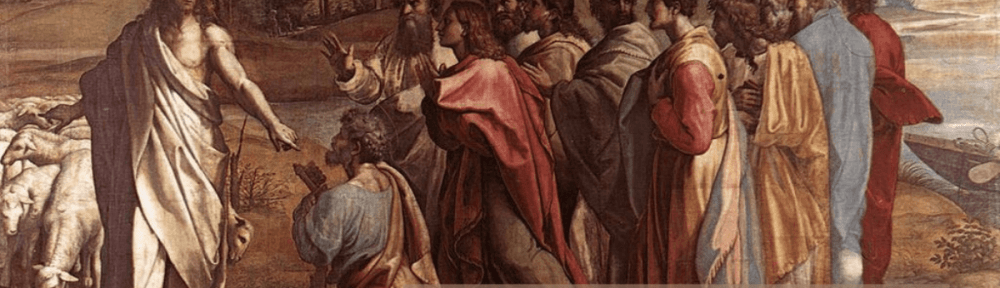
Image credit: Raphael, Handing-over the Keys, 1515, Victoria and Albert Museum, London | Public Domain
Discover more from friarmusings
Subscribe to get the latest posts sent to your email.
 friarmusings