This coming Sunday is the 25th Sunday in Ordinary Time, Lectionary Cycle A. In St. Matthew’s narrative we are firmly ensconced in the midst of Jesus’ instructions, not of the crowds, but of the disciples, preparing them for not only his death and resurrection, but also for their mission to the world. In other words Jesus is preparing them to be apostles, the ones sent – and preparing them to serve the new People of God being formed.
We again encounter a “gap” in the Sunday gospels, just as we did not read from Mt 17, the Lectionary assigns no Sunday reading from Matthew 19. Chapter 19 begins with the formula that signifies the end of one of Matthew’s five sections: “When Jesus had finished saying these things” (see also 7:28; 11:1; 13:53; and 26:1). Jesus’ Galilean ministry is finished. Nonetheless, many commentators (e.g., Jensen, Carter, and Boring) hold that chapters 19-20 should be read together. So, what is in Matthew 19? And why is it important to our reading of Mt 20?
Carter (Matthew and the Margins) titles his section on these two chapters: “The Alternative Households of God’s Empire.” He writes:
The coherence of these two chapters resides in pervasive cultural understandings of households. … They [Aristotelean tradition, Neo-pythagoreans, and Hellenistic Judaism] understood the household to consist of four dimensions, namely, three relationships (husband-wife; father-children; master-slave) and the male’s task of earning wealth. A power dynamic controlled the relationships in which the husband/father/master ruled over the wife/children/slaves. The household was hierarchical and patriarchal in that the male held power over women and children. It was marked by strict gender differentiation. …
The sections of chapters 19-20 reflect this household pattern: the husband-wife relationship (including divorce, 19:3-12), children (19:13-15), procuring wealth (19:16-30), being slaves (20:17-28). In addition, 20:1-16 is a parable about a householder administering his estate and hiring workers.
But while the chapters utilize this household structure, they do not endorse the then-existing cultural norm. Rather, the two chapters subvert this hierarchical and patriarchal structure by instructing disciples in a more equal pattern (cf. 20:12). Husbands are not to rule over wives but to participate in a “one-flesh” relationship (19:3-12); all disciples are children, there are no parents (19:13-15); following Jesus, not procuring wealth and status, defines discipleship (19:16-30); all disciples are slaves like Jesus, there are no masters (20:17-28). The parable of the householder in 20:1-16 exemplifies God’s distinctive and different ways of ordering life. The concluding story of Jesus healing the blind men who beg for mercy offers disciples hope that they too will be enabled by Jesus’ power to live this alternative and against-the-grain existence (20:29-34). That is, as Jesus journeys to Jerusalem to die, the chapters provide disciples with instruction on an alternative household that befits the empire or reign of God. [pp. 376-7]
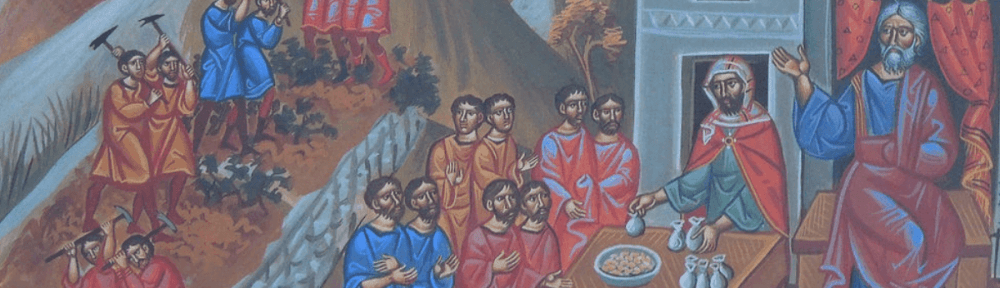
Image credit: Laborers in the Vineyard, icon | Public Domain | found on Flickr Fr. Ted
Discover more from friarmusings
Subscribe to get the latest posts sent to your email.
 friarmusings