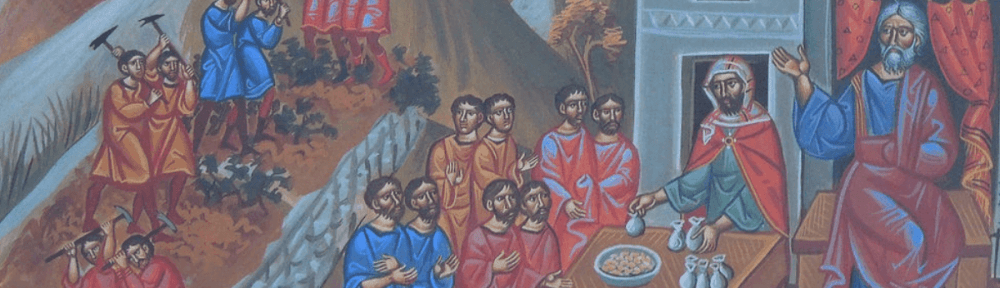
This coming Sunday is the 25th Sunday in Ordinary Time. This is a well-known parable in which a landowner goes out to the village to find day laborers. He goes out several times to engage more workers. The parable never says he needed more production, in fact, the landowner’s initial intention is never stated. Nonetheless, more and more workers are added to the labor force. One might hear an echo of Matthew 9:37 – “The harvest is abundant but the laborers are few.”
1 “The kingdom of heaven is like a landowner who went out at dawn to hire laborers for his vineyard. 2 After agreeing with them for the usual daily wage, he sent them into his vineyard. 3 Going out about nine o‘clock, he saw others standing idle in the marketplace, 4 and he said to them, ‘You too go into my vineyard, and I will give you what is just.’ 5 So they went off. (And) he went out again around noon, and around three o‘clock, and did likewise. 6 Going out about five o‘clock, he found others standing around, and said to them, ‘Why do you stand here idle all day?’ 7 They answered, ‘Because no one has hired us.’ He said to them, ‘You too go into my vineyard.’ 8 When it was evening the owner of the vineyard said to his foreman, ‘Summon the laborers and give them their pay, beginning with the last and ending with the first.’ 9 When those who had started about five o‘clock came, each received the usual daily wage. 10 So when the first came, they thought that they would receive more, but each of them also got the usual wage. 11 And on receiving it they grumbled against the landowner, 12 saying, ‘These last ones worked only one hour, and you have made them equal to us, who bore the day’s burden and the heat.’ 13 He said to one of them in reply, ‘My friend, I am not cheating you. Did you not agree with me for the usual daily wage? 14 Take what is yours and go. What if I wish to give this last one the same as you? 15 (Or) am I not free to do as I wish with my own money? Are you envious because I am generous?’ 16 Thus, the last will be first, and the first will be last.”
The parable begins in the familiar world in which day laborers are hired at sunup and are paid at the end of the day, in accordance with Torah regulation and Jewish practice (Lev 19:13; Deut 24:14–15). A denarius was a normal day’s pay for manual laborers hired by the day (cf. Tob 5:15; Ber. Rab. 61), but was barely enough to maintain a family at the subsistence level.
The first-century listener of the parable would begin to immediately notice there are things askew in the telling. Instead of sending his manager, the wealthy landowner himself goes to the market to hire laborers (cf. v. 8). The landowner goes repeatedly, even at “five o’clock” (lit. the “eleventh hour”). We are not told why the landowner is in need of so many workers. No explanation is given as to why those standing idle had not been hired on earlier recruitment visits. We are not told why the last hired workers were idle or why they were not seen standing in the market place earlier in the day. While we may try and fill in the gaps: it was harvest time; they were lazy; they were “hiding,” (note that in v. 6 he “finds” these last workers rather than “sees” them as in v. 3); such embellishments can be fun and fanciful, but they are saying more than the text indicates.
The first group of workers is hired on the basis of an oral contract for the “usual daily wage”; the later groups are promised “what is just,” thus raising, but not answering, the question of what is “just” (dikaios). Although the first group has a “contract” and the second can only trust in the master’s sense of justice, in reality both groups depend on the trustworthiness of the landowner. In the closing scene in which all are paid the same, the middle groups are ignored in order to focus on “first” and “last.”
Image credit: Laborers in the Vineyard, icon | Public Domain | found on Flickr Fr. Ted
Discover more from friarmusings
Subscribe to get the latest posts sent to your email.
 friarmusings