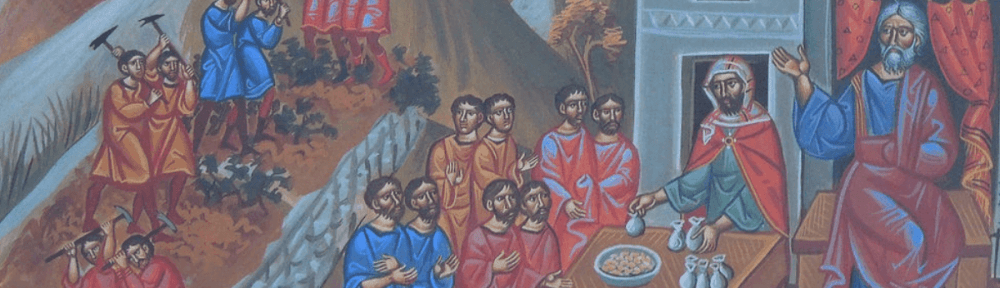
This coming Sunday is the 25th Sunday in Ordinary Time. The landowner has “hired” (misthoomai) the workers (ergates), which implies an offer to pay (misthos) them for their work. In contrast, Mt 21:28 has a father telling his son, “Go and work (ergazomai) in the vineyard today,” which may not involve payment for work done. An agreement (symphoneo) is reached between the landowner and the first workers. “I will give you what is just.” (Mt 20:4)
A denarius for one day’s work does not indicate a generous landowner. It was the minimum wage a family in poverty could exist on. This agreement speaks against interpreting this parable primarily as an illustration of God’s generosity. The wages aren’t that great. The workers have barely enough to live on. They remain in poverty, but their needs for this day will be met. Thus it may be better to translate agathos in v. 15 as “good” than as “generous”. It was good for the landowner to give the workers a minimum wage that was enough to live on for the day. It was not a generous wage.
In contrast to the first hired workers where an agreement was made about their wages. The other hired workers are told (v. 4): “I will give you what is just (dikaios which can also be translated, “right” “fair” or “proper”). This parable raises questions like: “What is right?” “What is just?” “What is fair?” God’s answers are not always the same as ours – and we may not always like God’s answers.
Image credit: Laborers in the Vineyard, icon | Public Domain | found on Flickr Fr. Ted
Discover more from friarmusings
Subscribe to get the latest posts sent to your email.
 friarmusings