This coming Sunday is the 25th Sunday in Ordinary Time. One of the things to appreciate about the gospels and their content within is to remember that Sacred Scripture is the Word of God, committed to writing under the inspiration of the Holy Spirit, using the powers and abilities of people.
“These divinely revealed realities which are contained and presented in sacred Scripture have been committed to writing under the inspiration of the Holy Spirit… they have God as their author…” (Dei Verbum, 11)
“…In composing the sacred books God chose men and while employed by Him they made use of their powers and abilities, so that with Him acting in them and through them, they, as true authors, consigned to writing everything and only those things which He wanted.” (Dei Verbum, 11)
As such, the content of Sacred Scripture will naturally have “levels” of not only author’s intent, but of human reception.
At its initial or basic level, the parable defended Jesus’ missionary methodology of reaching out to extend the blessings of the kingdom to tax collectors and sinners. Whereas his contemporaries believed these to be pariahs with no claim to salvation, Jesus’ words and works indicated that sinners were not only on equal footing with the righteous but were in fact the ones to whom God manifested special love and mercies.
At a second level, the parable, as remembered and preserved by the Matthean community, put forth the message that even gentiles who came “late” to the good news of salvation would enjoy the same benefits and those who were first to hear it viz., the Jews.
At another level, there is meaning based on the sequence of stories/parables/pericopes the evangelist (in this case Matthew) has constructed. This parable is framed by a doublet saying of Jesus concerning the reversal of fortunes (19:30: “But many who are first will be last, and the last will be first;” 20:16: “Thus the last will be first and the first will be last”). As such, the parable offered a lesson in discipleship. Christians are not to concern themselves with recompense for their service in the cause of the kingdom; nor are believers to presume to mete out what others deserve for the services they have rendered. Human standards of fairness have no place in the reign of God. All are abundantly rewarded by God whose only standard is a generous, merciful, forgiving love. If God were fair, in a strictly human sense, I wonder how many of us would enjoy the fullness of the kingdom.
Something else to ponder…
The German theologian, Fr. Karl Rahner has an interesting insight. He suggested that the daily wage or denarius which the owner of the vineyard gave to each hired worker is actually the gift from God of our very selves.
“Our own selves, just as we are: with our life, with our temperament, with our destiny, with our surroundings, with our time, with our heredity, with our family… These things cannot be negotiated or calculated. Whenever we complain about others with whom God has dealt differently, we are really refusing to accept our own selves from the hands of God.
This then becomes our life’s work, to accept the denarius whom we are as God’s generous gift, mysteriously and gradually revealed. This gift is made more precious by the knowledge that when we accept it, God gives himself with his gift. (The Great Church Year, Crossroad Publishing Co. New York: 1994)
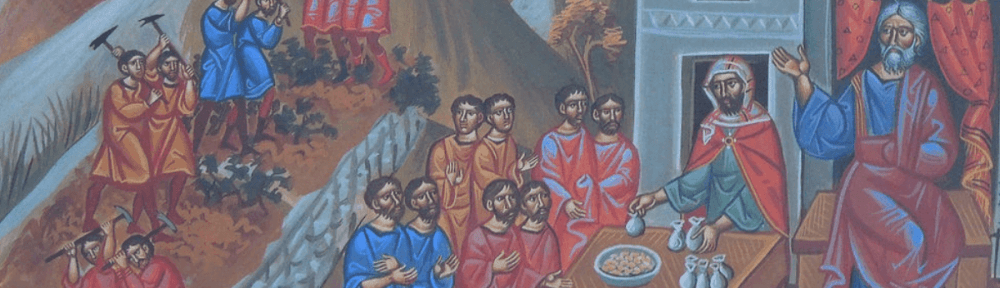
Image credit: Laborers in the Vineyard, icon | Public Domain | found on Flickr Fr. Ted
Discover more from friarmusings
Subscribe to get the latest posts sent to your email.
 friarmusings
A great “final thought “…you saved the best bit for last, Fr. George…love this, thank you!
the consciousness of a human person is an unfathomable ~~
IT IS our life’s work, to accept the denarius whom we are as God’s generous gift, mysteriously and gradually revealed