As you know (…or don’t know), September 19th was “Talk Like a Pirate Day.” While you may have missed the celebration this year – largely consisting of talking like a pirate throughout the course of the day – it is not too late to begin training for next year’s celebration. To that end, this particular post is offering you a short lesson in the key phrases and their etymology.
Avast – a nautical command to stop or cease. Avast is thought to come from the Dutch houd vast, meaning “hold fast.” For example if you had a landlubber onboard your ship about to do something dangerous or foolish, you might command, “Avast ye’ scurvy landlubber!”
Arrr, Arrgh, Yarr, Gar – word filler used to emphasize a point, best done in a low throaty voice.
Landlubber – Lubber is not a mispronounced lover, but an old word from Middle English referring to a “big clumsy fellow,” hence a term of mild derision for someone who hasn’t yet gotten their sea legs.
Scurvy – a nutritional disorder caused by a lack of vitamin C, it has historically led to disability and mortality among sailors on long sea voyages where such foods were scarce. Both noun and adjective forms of scurvy developed from scurf, a word referring to flakes of dead skin that dates back to Old English. The adjective scurvy originally meant “covered or affected with scurf” in the early 16th century but within a few decades began to be used to mean “contemptible” or “despicable” – and this later definition was pirated into the language of swashbucklers.
Sea legs – while at sea, the ability to walk steadily amidst the rolling action of the deck; also denoting the absence of seasickness.
Freebooter – synonyms for privateer or pirate; with accompanying verbs, gerunds and the like. It comes from the Dutch vrijbuiter, from vrijbuit plunder, from vrij free + buit booty.
Booty – pirate talk for “plunder,” has been in our language since the 15th century and can be traced to the Middle Low German word būte, meaning “distribution, share, plunder.”
Swashbuckler – “a swaggering or daring soldier or adventurer,” from combining a sense of the verb swash (“to act in a blustering and bullying manner”) with the noun buckler (“a small round shield held by a handle at arm’s length”).
Scallywag – an inexperienced pirate, a swashbuckler wanna-be. The phrase was considered an insult.
Ahoy – has been in use at least since the mid-18th century to call out, especially to a passing ship or boat. It tacks an a (as in aha) onto hoy, an older interjection used to draw attention to something or in driving animals. This hoy is thought to have arisen as a natural exclamation, but a second hoy, referring to “a small usually sloop-rigged coasting ship,” entered Middle English in the 1400s from the Middle Dutch hoei. In essence it means “Hey ship!” – but when afloat, on all days including “Talk Like a Pirate Day”, please use “ahoy.” Those found shouting “ahoy” will be forced to walk the plank.
Walk the Plank – a method of execution practiced on special occasions by pirates, mutineers, and other rogue seafarers. Captives were bound so they could not swim or tread water and forced to walk off a wooden plank or beam extended over the side of a ship. The fate of such was to become “shark bait.”
Dance with Jack Ketch – to hang; Jack Ketch was slang for the hangman. Ketch was an infamous English executioner employed by King Charles I.
Lily-livered – an insult for someone who displays cowardice. Medieval belief that the liver was the seat of courage. Combined with the pale color of the lily flower, the full expression points to a person who had no blood in their liver, showing up a as turning “white as a sheet”, thus having no courage.
Grog – refers to any alcoholic liquor, but is often reserved for rum cut with water. The term came about thanks to English admiral Edward Vernon, who reputedly earned the nickname “Old Grog”’ because he often wore a cloak made from grogram, a coarse, loosely woven fabric made of silk or silk blended with mohair or wool.
Jolly Roger – refers to a black flag raised by pirates carrying the dreaded skull-and-cross-bones emblem. It’s origin is not known, but it first appeared in Charles Johnson’s 1724 tome A General History of the Pyrates: “… their Hopes which had brought them very nigh, too late deceived them, for on the hoisting of Jolly Roger (the Name they give their black Flag), their French Hearts failed, and they both surrendered without any, or at least very little Resistance.”
Shiver me timbers – unlikely to have ever been uttered by an actual pirate. Instead, it is thought to have arisen from comedic literature as sailor-speak, mocking those attempting… apparently… to talk like a pirate without proper preparation such as offered by this post.
Dead men tell no tales – If the mob says “snitches get stitches”, pirates believe that dead men can’t tell anyone of their secrets. Historians believe this is why pirates were ruthless and didn’t spare many survivors. A final resting place might well be…
And last but not least…
Davy Jones’s locker – a metaphor for the oceanic abyss, the final resting place of drowned sailors and travelers. Davy Jones, according to the mythology of sailors, is the fiend that presides over all the evil spirits of the deep, and is often seen in various shapes, perching among the rigging on the eve of hurricanes, shipwrecks, and other disasters, to which a sea-faring life is exposed.
A bonus expression from the general nautical lexicon,
Three sheets to the wind – A ‘sheet’ is a rope controlling the trim of the sails. A sail (usually a jib sail) is said to be sheeted to the wind when it is set to backfill, set to the opposite side of the ship from normal use. As a storm gets stronger, more backfill counterbalancing is required to hold the ship in position, and additional jibs are sheeted to the wind to maintain the ship at a standstill. When a ship has three jibs sheeted to the wind, it is being held sideways to wind and waves in strong storm conditions with very high waves, causing it to roll wildly from side to side with each wave, in continuous danger of capsizing. Hence, “three sheets to the wind” has been used to describe a highly inebriated person who is no longer in control and is in danger of falling over.
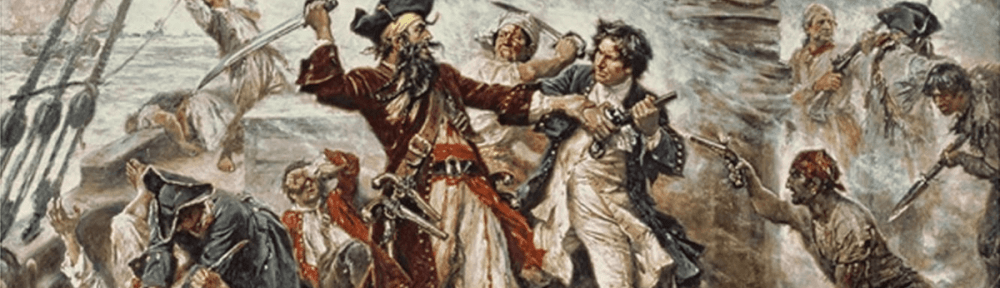
Image credit: Capture of the Pirate, Blackbeard, 1718 depicting the battle between Blackbeard the Pirate and Lieutenant Maynard in Ocracoke Bay – by Jean Leon Gerome Ferris | PD-US
Discover more from friarmusings
Subscribe to get the latest posts sent to your email.
 friarmusings