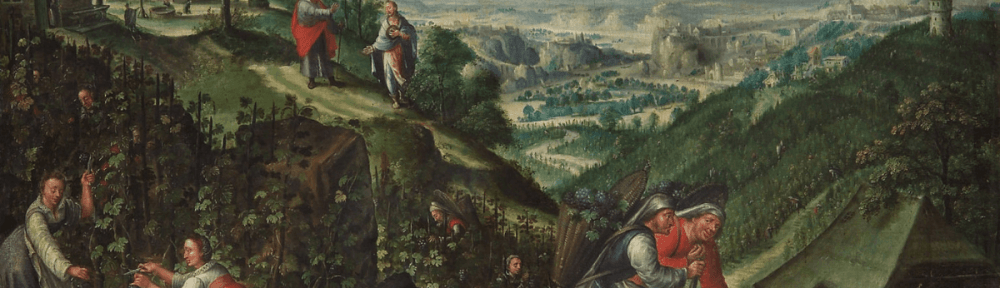
This coming Sunday is the 27th Sunday in Ordinary Time. The climax of the “Lord’s Vineyard” parable comes with the unexpected involvement of the landowner’s son following the servants. If the servants are the OT prophets, it is interesting to note that in Hebrews 1:1–2 “a son” as God’s last word follows prophets. Within the framework of the story the sending of the son is clearly a last resort, short of the owner returning himself (as he will eventually do in v. 40). When the son goes as his father’s messenger he goes with all his father’s authority, and so deserves “respect” and obedience. To reject the son’s demand is therefore the climax of rebellion. But to kill him is to add injury to insult. As a bid for independence and an attempt to gain possession for themselves it was hardly likely to succeed in a society under the rule of law, and it reads more as a spontaneous and ill-conceived impulse than as a calculated policy. But a parable does not have to fit into real life, and the points at which it becomes improbable are usually meant to draw attention.
The leaders of Jerusalem, I would suspect, understand the “son” to be a reference to Jesus and draw a conclusion of treasonous rebellion against the leaders of the Temple, as well as Roman rule. However, the Christian reader cannot fail to understand Jesus as the Son of God and the heir of the vineyard of Israel. For the Christian reader, Jesus’ death becomes Israel’s culminating act of rebellion, and may well reflect on how futile it was to try to escape from under God’s rule. To kill the son is an act of defiance to the father that will bring a cry for justice..
As mentioned above this expression might point to new people of God arising out of Jesus’ ministry and characterized by faith in him. We previously saw such a motif outlined in 8:11–12 and in the rabble of tax-collectors and prostitutes who “go ahead of” the chief priests and elders into the kingdom of God (vv. 31–32). The term ethnos, “nation,” calls for some such understanding, takes us beyond a change of leadership to a reconstitution of the people of God whom the current leaders have represented.
But on the other hand the singular ethnos does not carry the specific connotations of its articular plural, ta ethnē, “the Gentiles.” We may rightly conclude from 8:11–12 that this new “nation” will contain many Gentiles, but we saw also at that point that this is not to the exclusion of Jews as such but only of those whose lack of faith has debarred them from the kingdom of heaven. The vineyard, which is Israel, is not itself destroyed, but rather given a new lease of life, embodied now in a new “nation.” This “nation” is neither Israel nor the Gentiles, but a new entity, drawn from both, which is characterized not by ethnic origin but by faith in Jesus.
Some see an echo of Dan 7:27: “Then the kingship and dominion and majesty of all the kingdoms under the heavens shall be given to the people of the holy ones of the Most High, Whose kingship shall be an everlasting kingship, whom all dominions shall serve and obey.” If so, there is a poignant force in the transfer of this image to a different “people” which is not now simply Israel as Daniel had known it but which fulfills the role of the vineyard that is Israel.
What is lost by the current leadership and gained by the new “nation” is “the kingdom of God” represented by the personal authority of the landowner. The quotation in v. 42 has spoken directly of what “the Lord” has done in vindicating his Son. Israel, they have assumed, is where God rules, but they have rejected his will and so will find themselves outside his domain. At the same time, God will rule over a reconstituted “Israel” which acknowledges his sovereignty.
Image credit The Parable of the Wicked Tenants, Maarten Van Valckenborch, c. 1585, Kunsthistorisches Museum | Public Domain PD-US
Discover more from friarmusings
Subscribe to get the latest posts sent to your email.
 friarmusings