This coming Sunday is the 27th Sunday in Ordinary Time. The old tenants lost their place because they failed to produce the required fruit, and it is the distinguishing mark of the new “nation” that it will produce it. The point is not developed here, but this qualification potentially carries a warning also to the new “nation.” If it in turn fails to produce the fruit, it cannot presume on its privileged position. The next parable will contain a sobering final scene to just that effect (22:11–13).
Reflection (from Eugene Boring, The Gospel of Matthew, 415)
Who is represented by the “you” from whom the kingdom is taken? Who is the “nation” to whom it is given? In the context, the addressees are clearly the chief priests and Pharisees… the Jewish leadership, not the people as a whole. Thus some scholars… have contended that Matthew here and elsewhere claims only that God will replace the present false leadership with faithful leaders. This requires understanding “nation” (ἔθνος ethnos, which is also the word for “Gentile”) in an unusual sense, a new group of leaders for Israel. The more natural way is to understand ethnos as “nation” or “people,” so that (as in 1 Pet 2:9) those to whom the kingdom is given are the renewed people of God, the church of Jews and Gentiles, who are called by God in place of unfaithful Israel. Many Christians throughout history have been too willing to understand the text this way, which has fueled the fires of anti-Judaism and anti-Semitism. Many Christians today are hesitant to understand the text in any way that encourages a false understanding of supersessionism, that God has rejected Israel and replaced it with the church (Jewish and Gentile) as the people of God. Neither past mistakes nor present Christian sensitivity to Jewish-Christian relations should inhibit our allowing Matthew to mean whatever he meant. If he believed God had now rejected the Jews as the elect people of God and replaced them with the church composed of people called from all nations, including Jews, historical honesty should accept this. Historical exegesis may document this as Matthew’s view, even if his situational-conditioned perspective must not be allowed to dominate our own, which must be informed not only by this text but by other canonical perspectives as well, such as that of Paul, another Jew who had become a Christian and who saw a larger plan of God that embraced both Israel and church (Romans 9–11).
This text does not speak explicitly, however, of Israel’s being rejected, but of the “kingdom of God” being taken from “you”; in Matthew’s view, the saving activity of God continues in that community where taking up the “yoke of the kingdom” means adherence to the Torah as fulfilled in the teaching of Jesus (cf. 5:17–48; 28:20). Matthew, like the modern reader, here struggles with a difficult problem, one that he perhaps had as much difficulty in resolving with systematic clarity and consistency, as does his modern reader. Even if the objective meaning remains not entirely clear, contemporary readers can still legitimately ask whether they have set up other phony sovereignties in place of the one God, and thus might be addressed in the “you” from whom the kingdom is taken
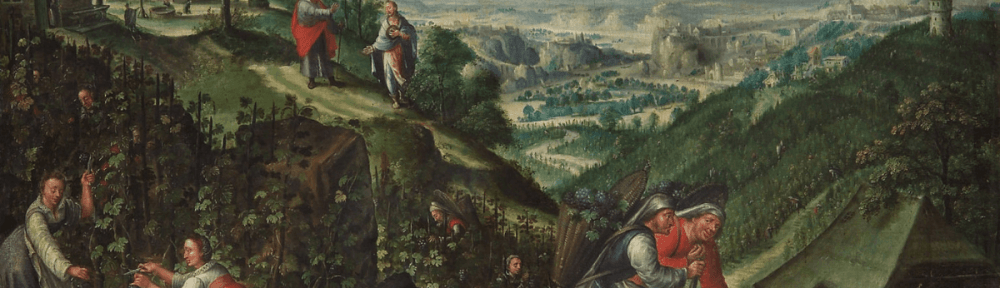
Image credit The Parable of the Wicked Tenants, Maarten Van Valckenborch, c. 1585, Kunsthistorisches Museum | Public Domain PD-US
Discover more from friarmusings
Subscribe to get the latest posts sent to your email.
 friarmusings