This coming Sunday is the 28th Sunday of Ordinary Time, Lectionary Cycle A. This Sunday our text is the third of three parables: (the two sons 21:28-32; the tenants in the vineyard 21:33-46; and now the wedding banquet 22:1-14). All three have images of father and son(s). The first two also have the image of a vineyard. The last two have the sending of servants, the murder of servants, and the punishment of the murderers. In each case, there is a distinction between those who do the will of the father/landlord/king and those who don’t. Scott (Hear Then the Parable) talks about all three parables starting with the first one:
The parable is the first of three that challenge the legitimacy of the Jewish leadership. They all expose Matthew’s ideology of the true Israel demonstrating the claims of the Pharisees to be false and those of the church true. The parables of the two sons, the wicked tenants, and the king who gave a marriage feast exhibit a progression from John the Baptist to the rejection of Jesus and punishment of those who rejected him through the final judgment, when those without a wedding garment will be cast out. [p. 81]
Luke’s version of the parable (Luke 14:16-24), also preserves the reversal motif and bears evidence of the evangelist’s conviction that the poor, outcasts, those otherwise marginalized from society will find a welcome in the kingdom. However, when Matthew’s rendering of this parable is compared to these other sources, there are several obvious differences. The main portion (vv. 1-10) of the parable is offered as an allegorical presentation of salvation history. The host has become a king (God) who was preparing a wedding banquet (symbol of kingdom) for his son (Jesus). The two groups of servants were probably representative of the Hebrew prophets and the Christian apostles, whereas the invited guests who repeatedly refused the king’s invitation and brutalized the servants were intended to portray Israel. People from the byroads represented the gentiles to whom the gospel was also to be extended.
The contribution of the Matthean church can also be detected in the incident regarding the guest who was ejected from the feast (vv. 11-13). Aware that God’s invitation to salvation was extended to all of humankind, good and bad alike, the early Christians were also aware that not everyone who received an invitation would remain as a guest. The improperly dressed guest represented those who had not cooperated with or appropriated the invitations that God had offered. As a result of his/her unresponsiveness, the improperly dressed guest forfeited a place at the banquet. It was then a reminder to the Matthean church that the divine invitations to love are a daily invitation. Thus one must possess a willingness to be daily transformed by God’s grace and according to God’s will. To do otherwise is to refuse the invite to the “wedding feast” or to appear improperly attired. Either open the road to an eternity of insatiable hunger and unquenchable thirst.
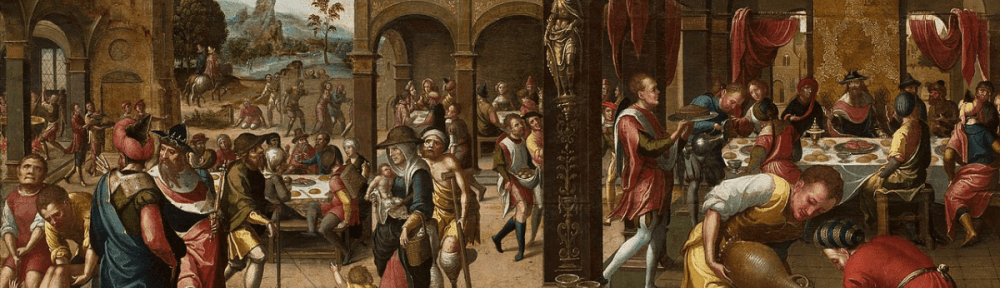
Image Credit: Parable of the Great Banquet by Brunswick Monogrammist (circa 1525) National Museum, Warsaw | Public Domain
Discover more from friarmusings
Subscribe to get the latest posts sent to your email.
 friarmusings