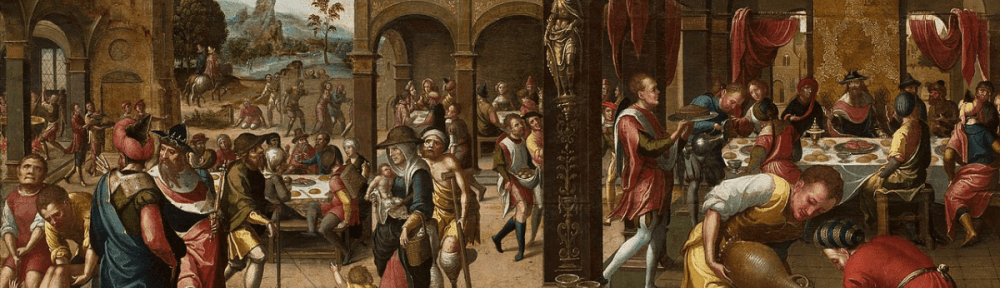
This coming Sunday is the 28th Sunday of Ordinary Time. “The kingdom of heaven may be likened to a king who gave a wedding feast for his son. He dispatched his servants to summon the invited guests to the feast” (Mt 22:2-3) Rabbinic and Hellenistic sources indicate that a two-stage invitation was quite normal – an ancient “Save the Date” coupled to the actual invitation itself. In the 1st century, the invitation was sent well in advance of the banquet. The invitation was acknowledged and accepted by those invited, who then received a courtesy reminder on the day of the banquet itself.
The problems begin “on the day” – but they refused to come. A second time he sent other servants, saying, ‘Tell those invited: “Behold, I have prepared my banquet, my calves and fattened cattle are killed, and everything is ready; come to the feast.”’ (Mt 22:3-4). The invitees who had committed themselves to attend the banquet simply declare their unwillingness/refusal to come (ouk ēthelon elthein). What are we to make of this reaction? There are two avenues often pursued: one personal, one political (of sorts). One could take the approach that the invitation to come was a threat to the invitees’ own pursuits. They want to do what they want to do when they want to do it. One goes to his field and another to his business. These aren’t excuses (as in Luke 14:18-20), but personal concerns that they think are more important than the king’s invitation to this most important celebration for his son.
On a political scale, refusal of a king’s invitation, especially by so many and so suddenly suggests something is afoot. There are two likely things: a general snubbing and disrespect toward the king, or perhaps more sinisterly, a conspiracy and that would be tantamount to rebellion (2 Sam 10:4). But then the king is a patient and accommodating person (again, cf. the preceding parable).
Either way, the unwillingness/refusal to come share the festive occasion with the King is to send the signal that loyalty and commitment are waning. In religious terms, people are wandering from the Covenant. Yet, the king does not strike out or retaliate, but sends a second group of slaves. This element of the story is peculiar to Matthew. Not only do those invited continue to refuse, but some go so far as to abuse and kill the messengers as well. If “a second time” (v.4) is considered the day of the feast – and there is good reason to do so since “everything is ready” – then it may be that Matthew is not talking about early and later prophets, but the Christian evangelists of Matthew’s own time. Certainly, many of the late-1st century evangelists were ignored; some were martyred.
Image Credit: Parable of the Great Banquet by Brunswick Monogrammist (circa 1525) National Museum, Warsaw | Public Domain
Discover more from friarmusings
Subscribe to get the latest posts sent to your email.
 friarmusings