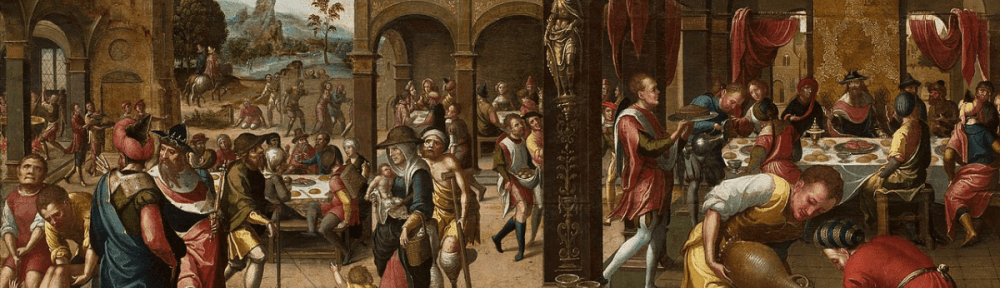
This coming Sunday is the 28th Sunday of Ordinary Time. This parable further clarifies not only the failure of the leaders and its consequence, but also the nature of the new “nation.” The king now extends his invitation: Then he said to his servants, ‘The feast is ready, but those who were invited were not worthy to come. 9 Go out, therefore, into the main roads and invite to the feast whomever you find.’
The “new nation” is symbolized now by an indiscriminate collection of people from the streets, people of no special standing, just as in Mt 21:31 it is the lowest social group who will get first into the kingdom of God. This feature of the story speaks of the universal proclamation of the good news of the kingdom of heaven.
The concept of a mixed community, within which not all will make it through to ultimate salvation, has been a recurrent feature of this gospel. Consider Matthew 7:13–27, especially the “impostors” of 7:21–23 who apparently thought they were all right, and later in Matthew’s gospel (25:1–13) where both wise and foolish bridesmaids are invited but only the wise get into the feast. Remember also Mt 13:36–43, where weeds and wheat are allowed to grow together and are separated only at the final judgment; also 13:47–50, in which good and worthless fish are gathered in the same net.
Scholars are of mixed opinion about the urgency of the “feast is ready” in v.8 as it applied to those invited when the servants scour the main road. One line of thought offers that these royal wedding feasts were several days in the making and even more in the execution. Not all guests came at the beginning nor stayed until the end. There was a great deal of coming-and-going during it all. There is no reason to suppose that, once invited, these people have no time to go home, to change their clothes, and to borrow clothes from their neighbors, if necessary.
For any such occasion guests would be expected to wear clothes that were both longer than those worn by ordinary people on working days and also newly washed. Those who could afford it would wear white, but it was sufficient for ordinary people to wear as near to white as washing their poorer quality clothes could achieve. Poor people, who might own only one patched tunic and cloak each, would often borrow clothes for occasions such as weddings or religious festivals.
How could those unexpectedly herded into the wedding hall from the main roads wear the expected clothing, which all but one of them seem to do? Again, realism is sacrificed to meaning. However, the issue has troubled some readers, and is normally addressed by the traditional speculation (deriving from Augustine) that the host was himself responsible for providing a wedding robe, so that this man’s fault was in his refusal to accept what was freely offered. While it is a nice thought, it lacks any convincing evidence in terms of contemporary wedding customs (see the Note on 22:11). The clothing expected at a wedding was not a special garment but simply decent, clean white clothes such as anyone should have had available. In that case the man’s fault is that, even though invited to a royal wedding, he had not gone home to change into his best; to turn up in ordinary, dirty clothes was an insult to the host. The symbolism is of someone who presumes on the free offer of salvation by assuming that therefore there are no obligations attached.
In early Christianity, the new identity of conversion was often pictured as donning a new set of clothes; the language of changing clothes was utilized to express the giving up of the old way of life and putting on the new Christian identity (see Rom 13:12–14; Gal 3:27; Eph 6:11; Col 3:12; cf. Luke 15:22; Rev 3:4; 6:11; 19:8). At the allegorical level, the man was expected to have the faith and deeds of an authentic Christian life, corresponding to the “fruits” in the imagery of the preceding parable. When confronted with his lack, the man has no response, for he is without excuse.
Image Credit: Parable of the Great Banquet by Brunswick Monogrammist (circa 1525) National Museum, Warsaw | Public Domain
Discover more from friarmusings
Subscribe to get the latest posts sent to your email.
 friarmusings