
The good folks at Merriam-Webster posted a list of words whose original meaning has morphed into something else, leaving us with an allusion that is obsolete while the word itself is still in use. For example, the expression “hang up.” For eons our parents have told us to “hang up” our clothes/coats. Often that meant to hang the coat on a wall mounted hook.
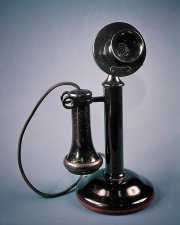 With the advent of telephones, the first generation of phones were vertically oriented with a device you picked up from its “hanger” in order to listen. When done you hung the device back in its cradle. Even in later generations of telephones, be they free standing or wall mounted, when you returned the receiver to its cradle, you “hung up” the phone – putting an end to the conversation. Perhaps naturally, if something or situation gives us pause or stops us in our tracks, we might be said to have a “hang up.” In the age of mobile devices, pressing an icon to end the call is still said to be “hanging up” even though there is no “hanger.” The allusion is obsolete but endures. Although I notice that Zoom and Microsoft Teams calls use the terminology “leave.” Perhaps full obsolescence is not far off.
Back in the day a carbon copy was a copy of a written or typed document produced using carbon paper. You’d insert two sheets of paper with a sheet of carbon paper between them into the typewriter, and the impact of the keys striking the top sheet transferred the letter to the second sheet via the carbon impression – the abbreviation at the bottom of the letter: “cc:” was followed by the people who were receiving the copies. As email became popular, carbon copy (cc:) suited developers as the term for a duplicate message sent to recipients other than that to whom the message is addressed. Apart from email, in figurative use, carbon copy describes one that is exactly the same (as in appearance) as another.
When someone describes a real-life situation as a “soap opera” one can assume a high degree of melodrama is present. Of course, we associate the term with daytime television shows, collectively called “soap operas.” But why are they called that? Soap operas began as radio serials, and are so named because they were originally sponsored by soap manufacturers, back in the days when a single product sponsored an entire program. Who knew?
When we hear the word “stereotype” we are more likely to think of a different kind of impression of a particular and shared characteristic about people, groups of people or even things. When speaking about people, the word often refers to an unfair or erroneous belief. That’s the modern usage. But a stereotype is a kind of printing plate once commonly used in newspaper publishing. Developed in the late 18th century, it’s made by locking different plates (containing columns, advertising, etc.) together to form a page and then, using a mold, forming a new plate to print the whole page at once. Most publishers don’t use stereotypes anymore, having moved on to photographic reproduction.
Another interesting expression is “dialed in.” In the world of sports it refers to absolute attention and readiness, e.g. a pitcher is “dialed into” the game. There are lots of variations on that meaning, but there is also the broadcaster’s warning: “don’t touch that dial,” that is don’t change the channel. Of course that made sense before the age of the television remote control; not so much today, but the warning is still understood. What about “dial it in” referring to making a report to someone using the telephone. Of course that is back when telephones had rotary dials. If you want to see a hilarious video about modern teens facing the older technology of rotary dials, watch this.
The idea of shopping at a dime store, also called a five-and-dime, might evoke a certain American era and remembering such stores, such as those owned by the F. W. Woolworth Co., might reveal a person’s age. The simple matter of inflation has caused dime stores to be replaced by dollar stores, also named for the typical price of the merchandise sold. Sadly, the expression “dime store” now serves as an adjective describing low quality merchandise.
I am sure there are more. Feel free to suggest a few in the comments section.
Discover more from friarmusings
Subscribe to get the latest posts sent to your email.
 friarmusings