I promise – this is the last background post….This coming Sunday is the Solemnity of Christ the King. It is probably right to read “least brothers” as a description of disciples. But to draw that conclusion does not establish that the “sheep” are commended because their treatment of disciples reveals their positive attitude to Jesus himself. For the striking feature of this judgment scene is that both sheep and goats claim that they did not know that their actions were directed toward Jesus. Each is as surprised as the other to find their actions interpreted in that light. They have helped, or failed to help, not a Jesus recognized in his representatives, but a Jesus incognito. As far as they were concerned, it was simply an act of kindness to a fellow human being in need, not an expression of their attitude to Jesus. They seem closer to what some modern theologians call “anonymous Christians” than to openly declared supporters of Jesus himself.
So it does not seem to be possible to read this passage as expressing a “Pauline” doctrine of salvation through explicit faith in Jesus. A systematic theologian can devise a scheme whereby justification by grace through faith and judgment according to works are together parts of a greater whole, but Matthew is not writing systematic theology, and the present passage brings to its fullest expression his conviction that when the Son of Man comes he will “repay every person according to what they have done.” (16:27) This is the ultimate outworking of the Matthean motif of reward for those who have lived according to the will of God. And that will is here spelled out in terms of the way people have responded to the human needs of “least brothers.”
That being said, as Boring points out, this scene is absent the language of grace, faith, justification, or the forgiveness of sin. “What counts is whether one has acted with loving care for needy people. Such deeds are not a matter of ‘extra credit,’ but constitute the decisive criterion of judgment presupposed in all of vv.23-25, the ‘weightier matters of the Law’ of 23:32.” [Boring, 1994, 455]
Sovereignty. The debate about the criterion of judgment, however, theologically important as it is, should not be allowed to distract the reader from what is likely the main thrust of this passage: its portrayal of the ultimate sovereignty of the Son of Man as the universal judge. This theme has been developed in Matthew echoing the imagery of Dan 7:13–14. That passage provides the language for the scene in v. 31. The sovereign authority displayed in the judgment on the temple (24:30) now finds its eschatological counterpart in the judgment of all nations (v. 32). The focus on Jesus’ parousia in the preceding part of the discourse from 24:36 to 25:30 encourages the reader to associate this final judgment also with the parousia, as part of the same complex of eschatological motifs, but the scene itself is apparently set, like that of Dan 7:9–14, in the heavenly throne room, to which all people are summoned. There is no indication within this passage of the Son of Man coming to earth, unless that is assumed to be the meaning of the language of Dan 7:13, and we have already seen repeatedly that that is not how the Daniel vision is framed. The word parousia is not used here. The “coming” of v. 31 is no more specifically parousia language than it was in 24:30 and in all the other allusions to Daniel 7:13–14; it is the context rather than the wording of this passage which allows the reader to associate this judgment scene with the time of the parousia. [France, 2007, 960]
Christological Titles
Eugene Boring points out that “a number of Christological titles important throughout Matthew converge in this scene.” Namely, “Son of Man” (v.31) who has “God as his father” (v.34). “King” which points to Messiah and Son of David – and also called “Lord.” He is the “messianic shepherd who cares for the sheep…and the judge who makes the final separation between sheep and goats.” [Boring, 1994, 455]
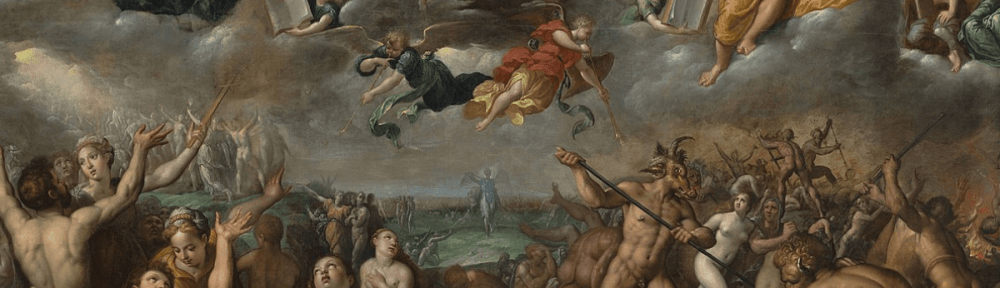
Image credit: Jacob Adriaensz Backer: Last Judgment (Matthew 25:31-33), National Museum in Warsaw, PD-US
Discover more from friarmusings
Subscribe to get the latest posts sent to your email.
 friarmusings