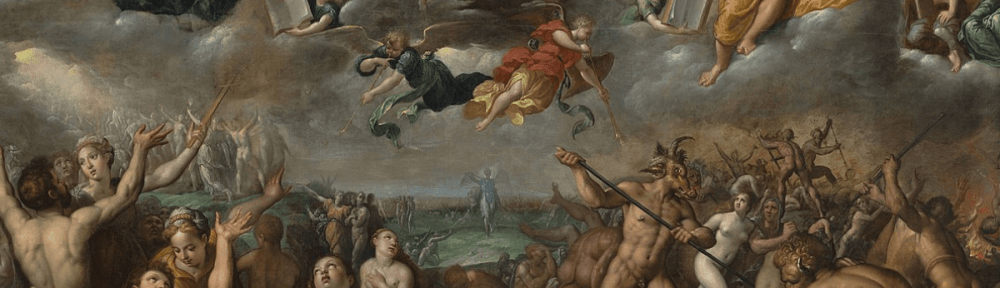
This coming Sunday is the Solemnity of Christ the King: 31 “When the Son of Man comes in his glory, and all the angels with him, he will sit upon his glorious throne, 32 and all the nations will be assembled before him.” Matthew, writing to a largely Jewish Christian audience, has, from the beginning, relied heavily on OT imagery and scenes. And as this commentary explores, and has already noted, the verses are particularly dense with OT references.
The imagery starts in the opening verse. The most evident echo is from Daniel and the wider setting found there: “As the visions during the night continued, I saw coming with the clouds of heaven One like a son of man. When he reached the Ancient of Days and was presented before him, He received dominion, splendor, and kingship; all nations, peoples and tongues will serve him. His dominion is an everlasting dominion that shall not pass away, his kingship, one that shall not be destroyed.” (Dan 7:13-14)
The Matthean use of “The Son of Man,” “comes,” “glory” all directly echo the verses in Daniel, as does the idea of enthronement. Matthew also echoes Daniel 7:9-10 from which we have the specific mention of “throne,” the gathering of angels, and the idea of judgment. There is one important difference. In Daniel’s scene it is God himself seated on the throne of judgment. In Matthew it is now the Son of Man, fulfilling what was depicted in Dan 7:14.
This fulfillment also points to something more. There is also an important translation that Matthew provides in v.34. There the Son of Man is described simply as “the king”: “Then the king will say to those on his right.” In this simple verse the promised kingdom of God (heaven) is identified and fulfilled in the kingship of the Son of Man (13:41; 16:28; 19:28; cf. 20:21). [France, 2007, 950]
Given the clear connection to The Book of Daniel, it is easy to pass over another echo in the phrase “all the angels with him.” One will find a similar phrase in Zech 14:5 which depicts the salvific coming of God accompanied by “all the holy ones.” In these climactic visions, then, the OT expectation of the eschatological visitation of God in judgment and salvation finds its fulfillment in Jesus the Son of Man who sits on his glorious throne and pronounces judgment. (Note: the Book of Revelation also joins Daniel and Zechariah to provide a passage that speaks to both judgment and salvation). [ibid]
As depicted in Joel 3:1–12, all the nations are gathered into judgment (see the earlier discussion on this phrase). Again, a passage that depicts God himself as judge, is echoed in a description of judgment by the Son of Man. In Joel the judgment is specifically of the Gentiles in relation to their mistreatment of Israel, but there is no such restriction here, and in the light of the judgment on Jerusalem in ch. 24 it seems likely that Jews and Gentiles together are called to this final examination. As discussed above, the eschatological tone of the whole pericope indicates that this judgment is universal, including both professing disciples and other people without distinction.
Image credit: Jacob Adriaensz Backer: Last Judgment (Matthew 25:31-33), National Museum in Warsaw, PD-US
Discover more from friarmusings
Subscribe to get the latest posts sent to your email.
 friarmusings