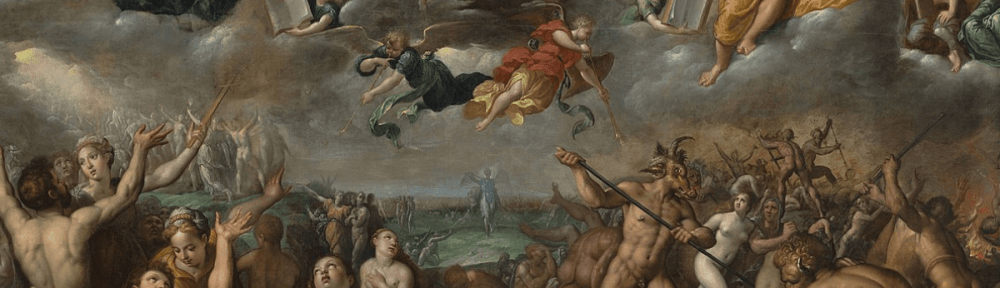
This coming Sunday is the Solemnity of Christ the King: 32 And he will separate them one from another, as a shepherd separates the sheep from the goats. 33 He will place the sheep on his right and the goats on his left. The distinction and division in the end times does not make its first appearance here at the end of Matthew. The image has recurred in many different contexts in this gospel; to note several instances: 7:13–27; 8:11–12; 10:32–33; 13:40–43, 49–50; 16:25–26 and the whole of 24:36–25:30. Now it is underlined by an image perhaps based on Ezek 34:17 where God, the shepherd, judges between different members of his flock. In the Middle East sheep and goats were (and are) often pastured in mixed flocks.
Joachim Jeremias, an eminent Scripture scholar of a previous generation and oft quoted spoke of the implied imagery within v.32, He held that sheep are the more valuable animals generally, but, moreover because of their white color in contrast to the black of the goats. Further this makes them a symbol of the righteous in this judgment scene. However, the sheep, though generally lighter colored than goats, are not as predominantly white as the flocks familiar to us; some are brown and some have substantial dark patches (even when clean!), so that it can take a practiced eye to distinguish the two species – a divine eye perhaps. [France, 2007, 961]
It is at this point the narrative takes on the form of a simile. The imagery provides a memorable illustration of the final division of people who have up to that point lived together indistinguishably — cf. the imagery of the wheat and the weeds (13:29–30) or of the foolish and wise bridesmaids (25:1–12). To other people (and even to themselves), the saved and the lost may look very similar; it takes the expertise of the “king” to know which is which. [France, 2007, 962]
The Blessed. 34 Then the king will say to those on his right, ‘Come, you who are blessed by my Father. Inherit the kingdom prepared for you from the foundation of the world. As noted above, the “Son of Man” is now depicted as “king.” It is the king himself who points out “my Father.” The Christological implications are clear – and even though it comes from the Gospel of John, one is hard pressed not to be reminded (John 5:27) where Jesus tells his disciples that all authority has been given to the Son to implement judgment.
“Blessed” (eulogeō) here is the same word as in the quotations of Ps 118:26 in Mt 21:9; 23:39. It denotes someone who enjoys God’s good favor; it is a more theologically loaded word than makarios, “happy” (traditionally translated “blessed”) as used in the Beatitudes.
The blessedness of those on the right hand is spelled out as inheriting a kingdom. As mentioned elsewhere “kingdom” would be better translated as “kingship” in order to indicate a ruling authority rather than a place. This kingdom/kingship which is sometimes taken to mean, as in the first and last Beatitudes in 5:3, 10, that they are confirmed as members of God’s kingdom, as his accepted subjects, who will therefore share its eternal blessings (summed up in v. 46 as “eternal life”). But this “kingship” is not here said to be “the kingdom of God/heaven”. Rather it is a kingship prepared “for you:” they themselves will become kings, sharing in the kingly authority of their Lord. This is what Jesus has promised to the Twelve in 19:28, and the same idea is found in Luke 12:32 where the kingship is given to the “little flock” of Jesus’ disciples. The theme of disciples sharing Jesus’ kingship will recur elsewhere in the NT: see 1 Cor 4:8; Eph 2:6; Rev 1:6; 5:10; 20:6; 22:5. Thus the “righteous” will receive the status of “kings,” an even stronger statement of the principle we have seen in 24:47; 25:21, 23 that faithfulness is rewarded by additional authority. [France, 2007, 962]
This new status is not an afterthought but the culmination of God’s purpose for them “from the foundation of the world.” We have noted in 20:23 (““My cup you will indeed drink, but to sit at my right and at my left (, this) is not mine to give but is for those for whom it has been prepared by my Father.”) the idea that God has already “prepared” who is to sit at Jesus’ right and left in his kingship; here the idea is extended beyond those specific places of honor to all who will “inherit” that kingship, and that decision predates the creation of the world. As with other such apparently deterministic language in the NT, it is possible to read “for you” here in either a more general or a more personal sense. Traditional Calvinism has favored the more rigorous, personal interpretation that concludes that the identity of the individuals who will enjoy these blessings is already decreed before they are born. Others have understood the “you” to refer to the class of the saved as a whole: God has prepared this kingship for those who will prove to be worthy of it, but who those people will be remains to be discovered on the basis of their response to the gospel and to the will of God. On that reading what is determined in advance is that those who prove at the time of judgment to be “sheep” will inherit the kingship, rather than that certain individuals have been “pre-selected” before their birth to be “sheep.”
Image credit: Jacob Adriaensz Backer: Last Judgment (Matthew 25:31-33), National Museum in Warsaw, PD-US
Discover more from friarmusings
Subscribe to get the latest posts sent to your email.
 friarmusings