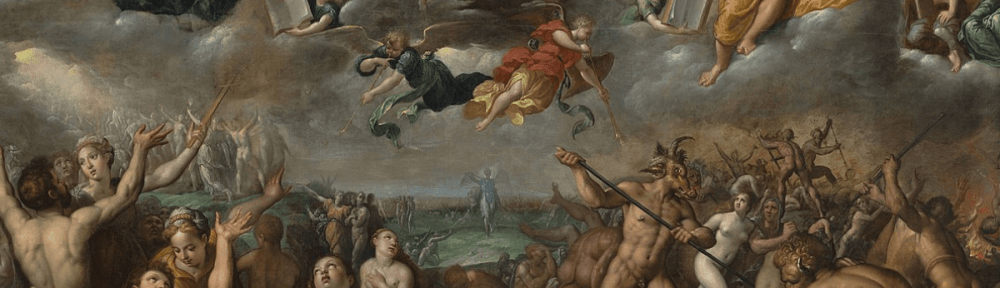
This coming Sunday is the Solemnity of Christ the King: 46 And these will go off to eternal punishment, but the righteous to eternal life.” There are only two possible outcomes to the judgment. The phrase “eternal life” is already familiar to us from 19:16, 29 (cf. also 7:14; 18:8, 9) where it has been seen to be synonymous with being saved or with entering the kingdom of heaven. This is, however, the only time we meet the phrase “eternal punishment” in Matthew, or indeed in the whole NT. It appears to be synonymous with the “eternal fire” of v. 41 and of 18:8, and cf. the “fire of Gehenna” of 5:22 and 18:9.
All these passages raise the question whether this fire is regarded as destroying and thus annihilating those consigned to it, or as a continuing agony of conscious punishment such as is explicitly attributed to the devil, the beast and the false prophet in the lake of fire in Rev 20:10. In the debate among evangelical theologians on the issue of annihilation as against continuing punishment, the phrase “eternal punishment” here in Matt 25:46 is commonly cited as a proof-text for the latter position. But this is usually on the assumption that “eternal” is a synonym for “everlasting.” That assumption depends more on modern English usage than on the meaning of aiōnios, which we have seen to be related to the concept of the two ages. “Eternal punishment”, so understood, is punishment that relates to the age to come rather than punishment that continues forever, so that the term does not in itself favor one side or the other in the annihilationist debate. In so far as the metaphor of fire may be pressed, however, it suggests destruction rather than punishment, especially if the imagery of the incineration of rubbish is understood to underlie the idea of hell (Gehenna was originally the dump site for Jerusalem where the city’s garbage was burned – and as you can imagine for a city such as Jerusalem – the fires were 24/7 and smoldered incessantly.) The fire of Gehenna goes on burning not because the rubbish is not destroyed by it, but because more is continually added. The imagery of incineration in relation to the final destiny of the wicked also occurs more explicitly in 13:42: the weeds are destroyed, not kept burning forever. We have also noted the use of the verb “destroy” in relation to hell in 10:28. These pointers suggest that an annihilationist theology (sometimes described as “conditional immortality”) does more justice to Matthew’s language in general, and if so the sense of “eternal punishment” here will not be “punishment which goes on forever” but “punishment which has eternal consequences”, the loss of eternal life through being destroyed by fire.
A Final Thought: Not Keeping Score. Richard Jensen (Preaching Matthew’s Gospel, 220-22) has comments from his book about this parable which I thought I would share:
The righteous are surprised. They don’t know their deeds. They haven’t kept score. Their left hand doesn’t seem to know what their right hand is doing (Matthew 6:3)….
The righteous were righteous because of their deeds and they didn’t know it. They didn’t know their own righteousness…. The righteousness of the sheep was precisely an alien righteousness. They didn’t even know they possessed it!…
Note that in the story the opposite is also true. The unrighteous ones know their deeds. They have kept score…. The unrighteous are quite confident about their righteousness. It is always so with humanly crafted righteousness. Those who measure their righteousness on human scales are in for a shock at the day of judgment. “Not everyone who says to me, ‘Lord, Lord,’ will enter the kingdom of heaven…” (Matthew 7:21)….
Jesus’ vision makes it clear. The life of the Christian is a life given in love to the least of these. But that’s good works, isn’t it? Won’t such good works for our neighbor destroy the “faith alone” foundation of our faith? (We Lutherans actually worry about this at times.) The answer to our question is “No.” Our good works will not destroy our “faith alone” posture. We can do all the loving of the least and little ones we can possibly imagine and not be liable to belief in works-righteousness. We are called to do lots of good works. We are also called not to keep score. When we keep score of our deeds we want to credit our love of neighbor to our heavenly bank account. Loving our neighbor is not the problem. Keeping score of our good deeds of neighbor-love is the problem. The truly righteous don’t keep score. Their left hand doesn’t know what their right hand is doing. Such as these will stand before the Sovereign one day clothed in Christ’s righteousness alone.
Image credit: Jacob Adriaensz Backer: Last Judgment (Matthew 25:31-33), National Museum in Warsaw, PD-US
Discover more from friarmusings
Subscribe to get the latest posts sent to your email.
 friarmusings