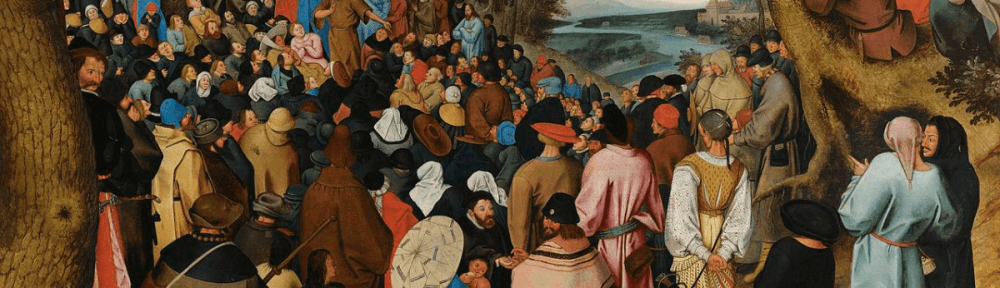
This coming Sunday is the 3rd Sunday of Advent. Last week the Gospel reading focused on the preaching and ministry of John the Baptist as the precursor or forerunner of Jesus, the one who came to “Prepare the Way of the Lord,” by calling the people to turn back to God. The readings often include passages from the Old Testament, particularly from the book of Isaiah, which contain prophecies about a voice crying out in the wilderness, making the paths straight for the Lord. This week John the Baptist is still prominent, but the readings move from penitential in nature to one that anticipates the coming of the Christ child. We also move from the Gospel of Mark to the Gospel of John.
The 3rd Sunday of Advent, often called Gaudette Sunday, is more joyful and celebratory compared to the previous weeks of Advent. “Gaudette” means “rejoice” in Latin, and it is a day of joyful anticipation. The readings often emphasize that the time of waiting is nearing its end, and the fulfillment of God’s promises is drawing closer. It is a reminder of the joy that comes with the anticipation of Christ’s arrival. The Gospel reading shifts the focus from a solely penitential and preparatory tone to one of joy and hope. It encourages believers to rejoice in the Lord’s coming and to maintain a sense of hope and expectation.
The gospel for this Sunday is taken from the prologue and beginning of the Gospel of John (John 1:1-28) it does not include all the verses. Our gospel reading uses verses 6-8 and 19-28. The passage does not include such well known verses such as “In the beginning was the Word, and the Word was with God, and the Word was God” (John 1:1) nor the verses that emphasize the “light” coming into the world – rather it concentrates on the role of John the Baptist as the one who announces the light and his testimony to the light come into the world.
While this Sunday does not make full use of John’s opening chapter, the whole of the Advent and Christmas season does.
In Lectionary Cycle B, the prologue and beginning of the Gospel appears on the 3rd Sunday of Advent as well as the gospel for the Mass on Christmas during the day (all years) and on the 3rd Sunday of Christmas (all years). In all the uses John the Evangelist is orienting the reader of the gospel with a fusion of traditional materials: a hymn about the pre-existing Word of God, John the Baptist, as well as many OT images. The goal of the fusion is most powerfully seen in the closing verses of the Prologue (vv.14-18) in which the language about God and Word (v.1) becomes the language about Father and Son (v.17). The story of the Word becomes identical with the story of Jesus. The Word became flesh (v.14) is the defining event of human history in which the relationship of God and humanity is forever changed in the Incarnation. The Incarnation means that people can see, hear, and know God in ways never before possible. Such is the effect of the divine light in the world. What came to be through him was life, and this life was the light of the human race (vv.3-4)
David Lose has a wonderful reflection that I thought good to include here:
There is, John says, a point to the universe. That is a debatable conclusion these days. Theories about the beginning of the cosmos, evidence of an expanding universe, the discovery of dark matter, and so on – all of this and more raise questions about whether there is anything or anyone behind the creation of the world and the point – or lack thereof – of our existence.
The typical – or at least culturally dominant – Christian response has been to argue backwards from the complexity of our present world to the existence of an intelligent designer. This assumes, of course, that chaos cannot ever result in something complex and useful. And it often leads to an embrace of a pre- if not un-scientific view of the world that is difficult for most of us to accept.
So is that our only choice – random meaninglessness or uncritical biblicism? I don’t think so, as John offers another model.
John doesn’t seek to prove the existence of a creator, you see, he confesses it. In fact, he sings it. When you read these first eighteen verses of John’s Gospel, what we often call the Prologue, you realize quite quickly that it is as much poetry as narrative, filled not with equations but metaphors, and therefore is far closer to a song than a scientific essay. John makes a confession, not seeking to prove but persuade the way all art persuades, through beauty.
And so John confesses that at the heart of all we do and are, and at the core of all that is, lives God’s Word, not merely existing but giving life, and not life in general but life with meaning and purpose. Life, that is, that gives light.
Skeptics on both the most liberal and most conservative ends of the spectrum may scoff at confession, seeking instead some kind of proof, whether scientific or scriptural. But John simply confesses with poetry, metaphor, and song that at the very core of the universe is the heart beat of God, the Word that gives life, and the Word that thereby also enlightens our life.
Faith, like love, can be understood only from the inside. And so the question isn’t simply whether you assent to this confession, but rather, when you sing John’s song, do you feel the light of the world pulsing through your voice?”
This is Advent – an invitation to enter into the inside, to be lifted up in love, and to let the song of your life in Christ be your testimony.
Image credit: “Saint John the Baptist Preaching to the Masses in the Wilderness” by Pieter Brueghel the Younger (1564–1638), Galerie de Jonckheere, Paris | US-PD
Discover more from friarmusings
Subscribe to get the latest posts sent to your email.
 friarmusings