This coming Sunday is the 3rd Sunday of Advent. This fourth question appears to come from outside the “delegation.” The meaning of v.24 (Some Pharisees were also sent) is not quite clear. Were they a rival delegation? Folks who took it upon themselves to interject, unhappy with the progress made by the official delegation and accordingly added some questions of their own. In any case, on this occasion their inquiry was natural: this man was preaching and baptizing. He was drawing crowds in the name of religion – and why does he baptize?
Leon Morris again: “Baptism was not a new practice in Judaism. It was the regular rite in the admission of converts from other religions. When such a conversion took place, the males of the family were circumcised and all, of both sexes, were baptized. This was seen as the ceremonial removal of all the pollutions contracted in the Gentile world. The novelty in John’s case and the sting in his practice was that he applied to Jews the ceremony that was held to be appropriate in the case of Gentiles coming newly into the faith. All Jews were prepared to accept the view that Gentiles were defiled and needed cleansing. But to put Jews in the same class was horrifying. The Jews were God’s people already. It is true that on the basis of certain Old Testament passages some people expected that there would be baptizing when the messianic age dawned (Ezek. 36:25; Zech. 13:1). But John had denied being the Messiah. It was all very perplexing and the Pharisees wanted to know more about it.” (Morris, 123)
Why does he baptize? There is no notion of John’s baptism of repentance (cf. Matt 3:1–12), because John’s baptism belongs solely to his witness. This becomes even clearer in the account of Jesus’ baptism in vv. 32–34. John is not depicted as an actor in Jesus’ baptism; John’s only role is to allude to it, for the text does not actually say that John baptized Jesus. God and the Spirit are the actors. Indeed, as vv. 31a and 33 make clear, John “knew” Jesus only because John had been told by God how to interpret the descent of the dove (v. 32).
John does not offer a detailed explanation, but rather uses the question to again point out the differences between himself and the Messiah. John quickly moves away from the topic of baptism to the person of Jesus. John does not depreciate the importance of baptism, but his baptism is not an end in itself. Its purpose is to point people to Christ (v. 31). John’s interest is in Christ and in nothing less. So he proceeds to tell his inquisitors that the Great One stands among them, though they do not know him (cf. v. 11). Then he repeats the words about his coming after him (v. 15). Finally he brings out the greatness of the one who was to come by referring to his own personal unworthiness. He was not worthy to loosen the thongs of the great one’s sandal. Loosening the sandal was the task of a slave; a disciple could not be expected to perform it. There is a rabbinic saying (in its present form dating from c. a.d. 250, but probably much older): “Every service which a slave performs for his master shall a disciple do for his teacher except the loosing of his sandal-thong.” John selects the very task that the rabbinic saying stresses as too menial for any disciple, and declares himself unworthy to perform it. He is unworthy of the most menial of tasks for the one who was to come after him. Humility could scarcely take a lower place.
The section closes with a note of place. These things happened at John’s normal spot for baptizing on the other side of the Jordan (i.e., from Jerusalem). While there are textual variations it seems that “Bethany” is the right reading. But quite early the location was lost sight of. The Evangelist adds “on the other side of the Jordan” to distinguish this locality from the better-known Bethany, which was near Jerusalem.
A final thought
The posts this week have been quite detailed and technical, but if one steps back and considers all that John the Evangelist is telling us in just these few verses – there is truly the occasion for great joy. All the promises of God to the patriarchs and prophets and coming to life in the arrival of the Messiah. And this is just the beginning of John’s gospel – there is more “good news” to come. Welcome to Gaudette Sunday!
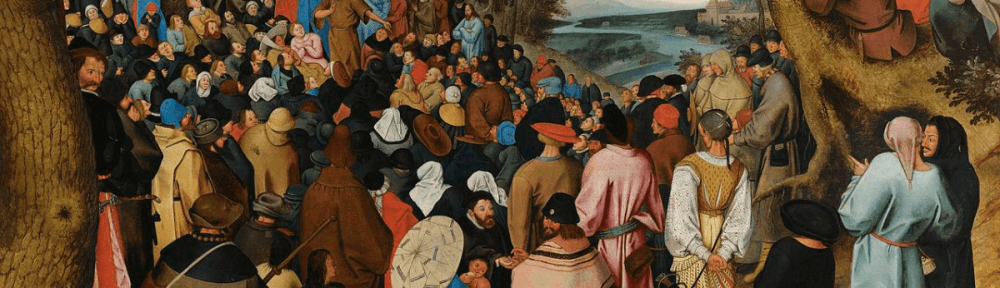
Image credit: “Saint John the Baptist Preaching to the Masses in the Wilderness” by Pieter Brueghel the Younger (1564–1638), Galerie de Jonckheere, Paris | US-PD
Discover more from friarmusings
Subscribe to get the latest posts sent to your email.
 friarmusings
baptism of Jesus is a mysterious event but iwth momentus occasion as u highlight ~~always puzzling in some waysmorepuzzling thaneverafter your insights