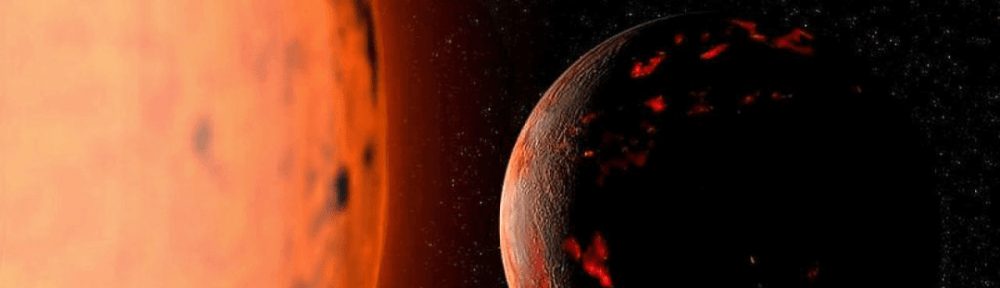
And by later, I mean 5 billion years or so, you just might witness what happens to planet Earth when our sun enters its red giant stage of life. We orbit around a G-type star (yellow dwarf) we call the Sun. When such a star reaches the end of life, it has depleted the hydrogen needed to keep the core nuclear fusion going. The star begins to turn to other internal fuel sources, loses mass, the core gets hotter and the plasma atmosphere expands. Eventually, our sun will grow more than 200 times as wide as its present size.
When that happens Venus and Mercury will be completely consumed. What about the 3rd rock from the Sun, also known as planet Earth? Long story short, Earth might be completely consumed or the atmospheric expansion might push farther out in orbit such that the 3rd rock (now apparently becoming the 1st rock) from the Sun will survive. But only the “rock” part. The atmosphere will have been long-since stripped away, the surface turned to ash along with any surface dwellers.
But as I mentioned this is 5 billion years or so down the road.
In 2020, a team from M.I.T. saw a star 12,000 light-years away temporarily become a few hundred times brighter. The flash was too dim to have come from a merger with another star. But it was just the right intensity to have been produced by a planet-size meal.
Rho Coronae Borealis is a yellow dwarf star 57.1 light-years (17.5 parsecs) away in the constellation of Corona Borealis. The star is thought to be similar to the Sun with nearly the same mass, radius, and luminosity. The star is reaching the end of its life. Three of its four known planets orbit close to the star, well within Venus’ path around our sun. The innermost of those worlds, thought to be rocky and nearly four times the mass of Earth, will be overtaken and evaporate within a few hundred years.
When a star like our sun expands into a red giant and sheds its outer layers, eventually the only thing left is a dense, white-hot stellar corpse known as a white dwarf. These objects contain as much as half the mass of the original star, packed into an area the size of Earth. They should continue to burn for trillions of years.
So, if you’re around later and the Earth we-used-to-know is pushed out into a different orbit, maybe you can watch the emergence of new life. Just saying…
Image Credit: fsgregs Creative Commons Attribution-Share Alike 3.0
Discover more from friarmusings
Subscribe to get the latest posts sent to your email.
 friarmusings
We can watch it together.
Too funny. 5B! Can science really predict this?
And who other than God will know?
YES MY SOUL and MIND and SPIRIT will be around to relish this time of the LORD of ALL CREATION !!