The Gospel of John is perhaps the most subtle of all the gospels with layers of meaning and nuance that can be overlooked in just the daily readings. Today’s gospel starts at John 1:43, but interestingly it leaves out the opening words (underlined): “The next day [Jesus] decided to go to Galilee, and he found Philip. And Jesus said to him, “Follow me.” Granted “the next day” is not needed for this pericope/snippet from the longer narrative, but if you have been reading along you’ll have noticed this is not the first occurrence of “the next day.”
The first chapter of John is testimony after testimony. As readers, from the very beginning we are told who and what Jesus is. The testimonies flow as follows:
First day (vv. 19–28). John the Baptist gives testimony to the priests and Levites. John is not Christ, nor the expected Elijah of Mal 3:23 nor the promised prophet-to-come of Deut 18:, but “the voice of one crying out in the desert,” to herald the one coming after him.
Second day (“next day” of vv. 29–34). John the Baptist again witnesses upon catching sight of Jesus. Jesus is “the Lamb of God who takes away the sin of the world,” the one on whom the Spirit descended and who baptizes with the Spirit; God’s chosen One.
Third day (“next day” of vv. 35–39). John the Baptist again witnesses, this time to two of his disciples: “Behold, the Lamb of God.” The disciples follow and and stay with Jesus
Fourth day (vv. 40–42). Andrew testifies to Simon: “We have found the Messiah.”
Fifth day (“next day” of vv. 43–51). Philip gives witness to Nathaniel: “the one about whom Moses wrote in the law, and also the prophets.” Then Nathaniel gives his own testimony: “You are the Son of God; you are the King of Israel.”
Seventh day (“On the third day” of 2:1–11). Jesus gives the witness via the miracle at the wedding in Cana “ … and so revealed his glory, and his disciples began to believe in him” (2:11).
Both the Book of Genesis and the Gospel of John begin with the same phrase: “In the beginning…” The gospel writer has constructed the telling as a re-creation of the world. In the Genesis account the Word of God was the creative force of all that is: “In the beginning was the Word, and the Word was with God, and the Word was God. He was in the beginning with God. All things came to be through him, and without him nothing came to be.” (John 1:1-3)
Now, there is a recreation of the world in seven days also centered on the Word of God: “And the Word became flesh and made his dwelling among us, and we saw his glory, the glory as of the Father’s only Son, full of grace and truth.” (John 1:14)
There is a lot going on here in just the first chapter of the Gospel of John
- Source: Diane Bergant and Robert J. Karris. The Collegeville Bible Commentary (Collegeville, MN: Liturgical Press, 1989)
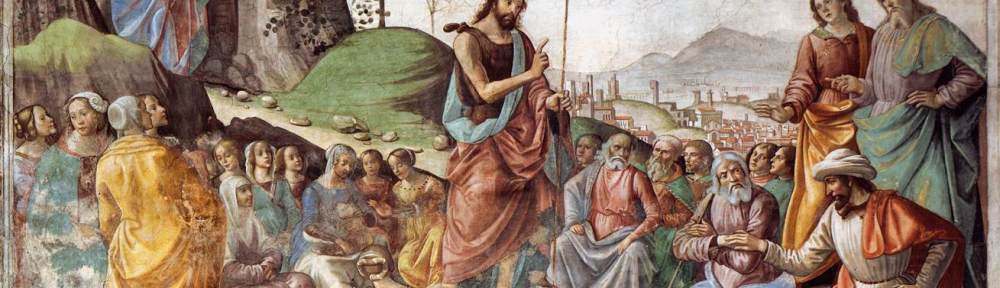
- Image credit: The preaching of St. John the Baptist. Chromolithograph by L. Gruner after C. Mariannecci after D. Ghirlandaio, 1490, Public Domain
Discover more from friarmusings
Subscribe to get the latest posts sent to your email.
 friarmusings