This coming Sunday is the 3rd Sunday in Ordinary Time in Lectionary Cycle B when our gospels are primarily drawn from the Gospel of Mark. The Gospel of Mark begins: “The beginning of the gospel of Jesus Christ the Son of God.” (Mark 1:1) And then in the following 13 verses, Mark introduces John the Baptist and his ministry in the wilderness “proclaiming a baptism of repentance for the forgiveness of sins.” (vv. 2-8), describes Jesus being baptized (vv.9-11), and then simply describes Jesus being driven by the Spirit into the wilderness (vv. 12-13).
Then, in an equally abbreviated style, Mark simply states that John has been imprisoned as he refers in passing to the whole story of John’s denunciation of Herod for immorality, and John’s consequent imprisonment and death (for full account, see 6:14–29). Here, the arrest incident serves as a marker of time as John the Baptist leaves the stage and our attention is redirected. From this moment on the spotlight is on Jesus who begins to proclaim the “good news of God.” (v.14)
What began as the “gospel of Jesus Christ, the Son of God” (v.1) is now the “good news of God.” Is v.14 the end of the prologue or the beginning of the public ministry of Jesus? It serves as both, a lynchpin between the herald and the promised One to Come. Jesus’ first words mark the transition from promise to “…the time of fulfillment” (v. 15).
The phrase, “time of fulfillment” appears only in Mark uses the Greek kairos, a word that the Church has typically designated as “God’s time” as opposed to kronos – the time of the world. What has been fulfilled? In Mark 1:2 we read, “As it is written in Isaiah the prophet: “Behold, I am sending my messenger ahead of you; he will prepare your way.” John the Baptist is announcing that the appointed and predicted time described by that Scripture is realized. What was written had now come to pass; the Messiah has come. But John may have announced more than he understood. Jesus’ initial proclamation of the nearness of the kingdom (v.15) seems to speak of something more: the kingdom of God.
14 After John had been arrested, Jesus came to Galilee proclaiming the gospel of God. This coming Sunday is the 3rd Sunday in Ordinary Time. Is it significant that Jesus does not enter upon his own distinctive ministry until after John has been arrested? Only Mark seems to make the distinction. The other gospel writers have the two ministries operating at the same time. Nonetheless, Mark notes Jesus’ ministry as beginning “After John had been arrested.” The Greek word for “arrested” is paradidomi – the word that is used for Jesus’ “betrayal” or “handing over” in 12 other verses of Mark’s gospel.
Perhaps the clear cut distinction between the time of the two ministries is to keep the sense of John as the precursor, not only in terms of message “repentance;” but also in terms of “being handed over;” and in terms of death. The arrest of John and the beginning of Jesus’ ministry suggest that this will be the “way of things,” that the gospel will be proclaimed amidst adversity and suffering, not in ease and comfort.
Mark’s formulation also suggests that Jesus is restrained by God from his ministry of proclamation until the Baptist is removed from the scene. His arrest indicates that the time has come for Jesus to act. Jesus enters into Galilee proclaiming the gospel of God. While some suggest that Jesus, at the arrest of John, is escaping heading to Galilee. Given that Herold rules in Galilee (see Mark 6:14-29), that is hardly likely.
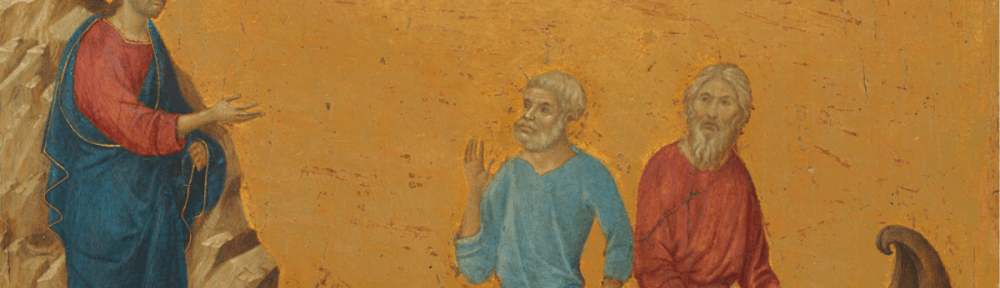
Image credit: The Calling of the Apostles Peter and Andrew, Duccio di Buoninsegna, National Gallery of Art Washington DC PD-US
Discover more from friarmusings
Subscribe to get the latest posts sent to your email.
 friarmusings