This coming Sunday is the 3rd Sunday in Ordinary Time. The exact meaning of the expression “kingdom of God” is nowhere explicitly defined. In modern English we tend to think of “kingdom” as having geographical boundaries with associated royalty. The Greek word used is basileia which can mean kingdom in the same way, but as with its corresponding words in Hebrew and Aramaic, the more common meaning refers to “sovereign authority.” In the Old and New Testaments the Kingdom of God is often referred to in universal terms, but since this earth is the scene of universal rebellion against God, the Kingdom of God is the sphere in which, at any given time, His rule is acknowledged.
God has not relinquished His sovereignty in the face of rebellion, demoniac and human, but has declared His purpose to establish it. And so God gave the Law to a nation and appointed leaders, judges and kings to proclaim divine sovereignty to the people and administer God’s justice. But the story of the chosen people is an uneven story of allegiance to the Kingdom, open rebellion against it, and benign indifference in between. While the presence of the Kingdom was intended to be exhibited in Israel, the Son of God was rejected, as it was declared, “We have no king except Caesar.” From this point all people are called without distinction of race or nationality, to submit voluntarily to the divine sovereign authority of the Kingdom. In our day the Kingdom is said to be ‘in mystery’ (Mark 4:11), but is spiritually discerned (John 3:3 and 1 Cor. 2:14). When God finally asserts His rule universally, then the Kingdom will be in glory, that is, it will be manifest to all.
The emphasis upon the “kingdom,” however, links his proclamation to the self-revelation of God in the OT and stresses the continuity between the new and older revelation. In announcing “the kingdom of God,” the accent falls upon God’s initiative and action. The kingdom of God is a distinctive component of redemptive history. It belongs to the God who comes and invades history in order to secure man’s redemption. The emphasis falls upon God who is doing something and who will do something that radically affects men in their alienation and rebellion against himself.
The kingdom may be proclaimed as near, if God’s decisive action in its realization has already begun. John’s ministry centered upon the urgent demand for repentance because God was about to act decisively in bringing among the people “the Coming One.” Jesus then proclaims that the kingdom has drawn near, and while his proclamation is veiled, Mark clearly understands that it is Jesus’ own appearance which is the decisive event in the redemptive plan of God. The coming of the kingdom remains in the future, but it is certain precisely because God has begun to bring it to pass in the coming of his Son. The announcement that the consummation is at hand affirms that the decisive events in its approach are under way. The Anointed One is already present among the covenant people, and through him the royal act of God in redeeming his people has begun. The kingdom has drawn near in the person of Jesus who embodied the kingdom in a veiled way. In the person of Jesus men and women are confronted by the kingdom of God in its nearness. A faithful response to the proclamation of the gospel is imperative.
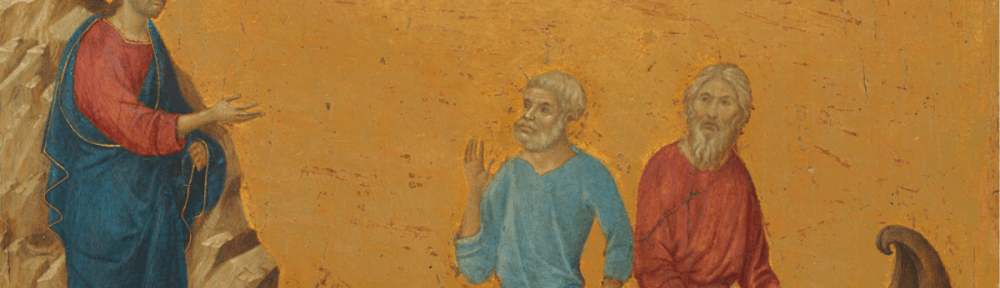
Image credit: The Calling of the Apostles Peter and Andrew, Duccio di Buoninsegna, National Gallery of Art Washington DC PD-US
Discover more from friarmusings
Subscribe to get the latest posts sent to your email.
 friarmusings