This coming Sunday is the 3rd Sunday in Ordinary Time. “Repent, and believe in the gospel.” (Mk 1:15) John Williamson, (Mark, p.43) offers this analogy which “may capture some (not all) dimensions of this summary of the preaching of Jesus.”
In a crowded airline terminal, hundreds of persons are scurrying in dozens of directions. Above the steady buzz of noise a voice booms through a loud-speaker, “Flight 362 is now arriving at gate we. Will passengers holding tickets for New York please check in at gate 23; you will be boarding soon.” Some people, of course, never hear the announcement and continue on their way. Others hear it but, having reservations on another flight, pay no attention. Some, however, who want to go to New York and who have been nervously awaiting such an announcement, look up expectantly, check their ticket for the flight number, gather their baggage, turn around and set out with some urgency for gate 23.
Our openness to hear and believe and act on the proclamation is key. Some act; some don’t.
The summons to “repent and believe in the gospel” is not new, but a fresh reiteration of the word addressed to men through the prophets. But the note of urgency in the summons to repent is sharpened, for now the nature of the gospel is clearer than ever before. The brief parable of the fig tree preserved by Mark in Ch. 13:28 echoes Jesus’ proclamation that the kingdom has come near and clarifies why the nearness of the kingdom imposes radical demands upon men: “When the branch becomes tender and the leaves are about to sprout, you know that the summer has come near”; i.e., the summer is the next thing that comes.
Jesus’ action in the wilderness of confronting Satan and then again in the ministry in the face of sin, disease and death, and the subduing nature – all these are signs that the end stands as the next act of God in man’s future. Provision has been made for men to repent, but there is no time for delay. Only through repentance can a man participate with joy in the kingdom when it does break forth. Jesus accordingly calls men to radical decisions.
In Jesus men are confronted by the word and act of God; he himself is the crucial term by which belief and unbelief come to fruition. Jesus proclaims the kingdom not to give content but to convey a summons. He stands as God’s final word of address to man in man’s last hour. Either a man submits to the summons of God or he chooses this world and its riches and honor. The either/or character of this decision is of immense importance and permits no postponement. That is what repentance is all about. The radicalness of Jesus’ kingdom proclamation is well caught in the saying, “He who is near me is near to the fire; he who is far from me is far from the kingdom” (Coptic Gospel of Thomas, Logion 82). Jesus himself, though veiled in the midst of men, becomes the crucial term by which men enter the kingdom of God, or exclude themselves from it. What he does is the work of God.
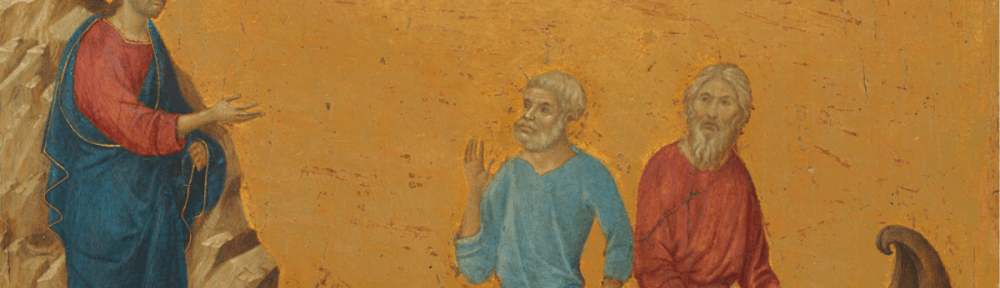
Image credit: The Calling of the Apostles Peter and Andrew, Duccio di Buoninsegna, National Gallery of Art Washington DC PD-US
Discover more from friarmusings
Subscribe to get the latest posts sent to your email.
 friarmusings