This coming Sunday is the 5th Sunday of Ordinary Time in Lectionary Cycle B. The narrative moves quite quickly in the Gospel according to Mark. The narrative’s pace and immediacy is one of the most notable attributes of the writing sty;le Lest one think that Mark is simply concatenating stories without a larger vision in mind, it is always good to “step back” and see the larger framework in which the Gospel account exists.
The first major section of Mark’s Gospel extends from 1:14 to 3:6, and describes the initial phase of the Galilean ministry. Within this section the evangelist records the calling of the first disciples , Jesus’ ministry in and around Capernaum, and a series of controversies which are climaxed by the decision to seek Jesus’ death. While that covers the “big picture,” in our Sunday gospels so far: Jesus has proclaimed the Kingdom of God is at hand, called the first disciples to follow him, taught with authority in the synagogue in Capernaum so that the people “were astonished at his teaching”, cast out a demon from a possessed person – “‘He commands even the unclean spirits and they obey him.’ His fame spread everywhere throughout the whole region of Galilee.” (Mark 1:27-28) Jesus not only speaks with authority — he also acts with power! The “amazed” bystanders acknowledge the teacher’s authority, yet they still have to ask: “What is this?” (v. 27).
In our gospel reading, Jesus and his disciples remain in Capernaum, a small fishing village on the northern shoreline of the Sea of Galilee. Tradition has it that Simon Peter’s home is just across the way from the synagogue in Capernaum. During Jesus’ brief stay in Capernaum, our gospel reading captures the following key moments:
Healing Peter’s Mother-in-law (1:29-31)
The Sick Healed at Evening (1:32-34)
Departure from Capernaum (1:35-39)
Last week’s scene which included the casting out of a demon almost stands in contrast with this week’s less dramatic healing. I would suggest that Mark intends the two stories to be read together – but the editors of the lectionary saw fit to be read on two different Sundays.
The first clue about their connectedness is that v. 29 begins “and immediately” (kai euthus – for some reason the translators of the NAB reduces the whole phrase to “On” losing the Greek intensity of the phrase). Let me just offer the following about the important contrasts between the first healing (1:21-28; casting out demons) and the second (1:29-31; cure of Peter’s mother-in-law):
| man | woman |
| synagogue (holy place) | house (common place) |
| (supernatural) unclean spirit | (natural) fever |
There is no limit to Jesus’ power and authority. It is for all people, in all places, and in all circumstances (natural and supernatural).
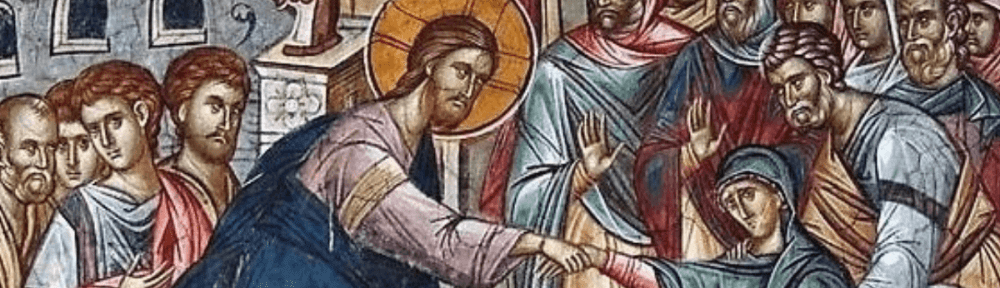
Image credit: Monastery Decani, South Wall, Christ’s Miracles (59) – Christ heals Peter’s Mother in Law | PD-US
Discover more from friarmusings
Subscribe to get the latest posts sent to your email.
 friarmusings