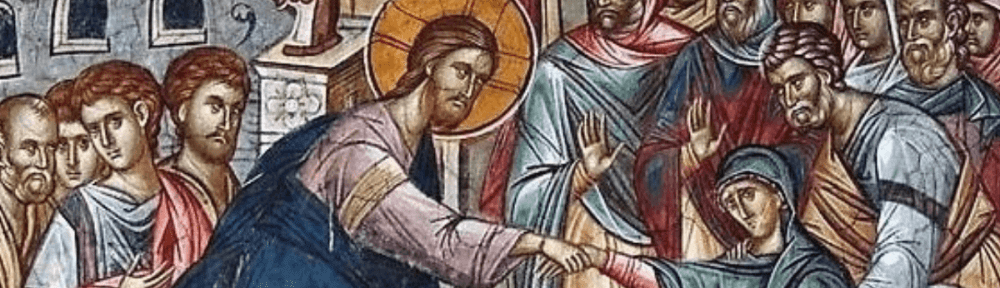
This coming Sunday is the 5th Sunday of Ordinary Time. It is very easy to simply note that Jesus cured Peter’s mother-in-law, be swept along in Mark’s breathless pace, and wonder if there is more to the story than meets the eye. Ched Myers (Binding the Strong Man: A Political reading of Mark’s Story of Jesus, 141) raises this question at the beginning of his comments on Mark 1:21-39:
These “miracle” stories raise important issues of interpretation. Is Jesus simply “curing” the physically sick and the mentally disturbed? If so, why would such a ministry of compassion raise the ire of the local authorities?
Certainly one can make a case that the ire of local authorities is raised because Jesus does all this on the Sabbath when they are not “emergencies.” The Pharisees and others were not heartless people, but they seem to insist that all this healing and such can wait one more day since it does not involve life threatening situations. They miss the point that these are signs of the in-breaking of the Kingdom of God. Or maybe they don’t miss the point and Jesus’ implied claims are the problem. In modernity, such a dynamic is more easily seen than other points of contention. Myers goes on to suggest: “There must be more to these stories than is immediately obvious to the modern reader.”
Ben Witherington III (The Gospel of Mark: A Socio-Rhetorical Commentary, 98) suggests some possibilities of why Jesus’ actions raised the ire of local authorities:
Though there are later stories of rabbis taking the hand of another man and healing him, there are no such stories of rabbis doing so for a woman, and especially not for a woman who was not a member of the healer’s family (b.Ber. 5b). In addition, there is the fact that Jesus performed this act on the Sabbath. Thus, while touching a non related woman was in itself an offense, and touching one that was sick and therefore unclean was doubly so, performing this act on the Sabbath only compounds the social offense. But this is not all. The service of Peter’s mother-in-law to Jesus (and the others) itself could have constituted work on the Sabbath, depending on what was done (.e.g., preparing food). In any case, later Jewish traditions suggest that women should not serve meals to male strangers. The important point about Jesus, however, is that he does not see the touch of a woman, even a sick woman, as any more defiling than the touch of the man with the skin disease. Jesus’ attitudes about ritual purity differed from those of many of his fellow Jews.
The healing of Peter’s mother-in-law is a somewhat contained story and we, not burdened by 1st century ideas of religious purity and uncleanliness, do not find the situation one which would raise our ire. Or do we? But in our own lifetime we have considered some people “untouchables,” e.g., those with AIDS, with mental illnesses, etc. These are different forms of societal purity and uncleanliness. When we consider the underlying attitude of quarantining people who may have been exposed to a virus, we can begin to gain some insight into the 1st century viewpoint.
As Ben Witherington noted, it is unlikely that the people wanted Jesus executed just because he miraculously healed people. He threatened their way of thinking, their cultural stereotypes, their understanding of religious purity.
Image credit: Monastery Decani, South Wall, Christ’s Miracles (59) – Christ heals Peter’s Mother in Law | PD-US
Discover more from friarmusings
Subscribe to get the latest posts sent to your email.
 friarmusings