This coming Sunday is the 5th Sunday of Ordinary Time. 35 Rising very early before dawn, he left and went off to a deserted place, where he prayed. 36 Simon and those who were with him pursued him 37 and on finding him said, “Everyone is looking for you.” 38 He told them, “Let us go on to the nearby villages that I may preach there also. For this purpose have I come.” 39 So he went into their synagogues, preaching and driving out demons throughout the whole of Galilee.
The Wilderness. This narrative, which like the preceding two is told from Peter’s perspective (note v.36 “Simon and those that were with him”), is intended by Mark to be associated with the report of the crowds that came to Jesus for healing the previous evening. This is indicated both by the time sequence in v.35 and the reference to the fresh gathering of a multitude seeking Jesus’ benefactions in v.37. The vivid phrase “Rising very early before dawn” may reflect the perspective of Simon, who discovered that Jesus was gone, and initiated the search for him.
The fact that Jesus left the village while it was still dark and sought a solitary place where he prayed is interesting from two points of view. (1) To describe the site of prayer Mark uses a double term meaning literally “wilderness place.” The description is inaccurate geographically, for the land about Capernaum was cultivated during this period. Its reference is to a place of solitude which in some sense recalls the wilderness. This is confirmed from the other two passages where this terminology occurs (1:45; 6:31–33). These passages share certain formal characteristics with 1:35: in each instance reference to the wilderness-place is preceded by an account of Jesus’ preaching and power; he then withdraws from the multitude which seeks his gifts, with the result that the people (in 1:35–37 their representatives) pursue him to the solitary place to which he has gone.
These texts suggest that Jesus deliberately withdraws from the people to return to an area which has the character of the wilderness where he encountered Satan and sustained temptation. The nature of the temptation in each instance may be related to the clamor of the crowds, who are willing to find in Jesus a divine-man who meets their needs and so wins their following. The people, however, have no conception of what it means to go out to the wilderness to bear the burden of judgment, as Jesus has done. He turns from their acclaim, returning to a place which recalls his determination to fulfill the mission for which he has come into the world. The passages which speak of “a wilderness place” thus refer back to the prologue to the Gospel, with its distinctive wilderness-theology.
Prayer. (2) The second point of interest is the reference to Jesus’ praying. In Mark’s Gospel Jesus is seen in prayer only three times: at the beginning of the account, when his ministry is being defined (Ch. 1:35), in the middle after the feeding of the five thousand (Ch. 6:46), and near the conclusion when Jesus is in Gethsemane (Ch. 14:32–42). These three occasions have the character of a critical moment. The setting for Jesus’ prayer in each instance is night and solitude, for even in Gethsemane Jesus is quite alone in spite of the three disciples who are separated a short distance from him. The situation again recalls the wilderness when Jesus confronts the temptation of Satan, and is sustained by help from God. His strength is in prayer through which he affirms his intention to fulfill the will of God, which means his submission to the judgment of God on behalf of the many who return to the wilderness without understanding.
Why He Came. When the crowds returned to the house in the expectation of finding Jesus, Simon and those with him, presumably Andrew, James and John, looked for him. There is a note of reproach in the statement, “Everyone is looking for you” which means, What are you doing here when you should be in the midst of the multitude who are clamoring for you? A very considerable impression had been made in Capernaum, and in the mistaken thinking of the fishermen it was this response which Jesus had sought to elicit.
Jesus’ answer indicates their failure to understand him or his mission. Acts of healing and expulsion of demons, as much as proclamation, entailed a disclosure of the nature of the kingdom of God and constituted a demand for decision. By his decision a person was qualified for participation in the kingdom or marked for judgment. The crowds that gathered in Capernaum had made their decision, but it could not be the appropriate one because it involved not repentance but attraction to Jesus as a performer of miracles. That is why Jesus interrupts the miracles to go elsewhere to proclaim “the gospel of God.” His purpose is not to heal as many people as possible as a manifestation of the kingdom of God drawn near in his person, but to confront men with the demand for decision in the perspective of God’s absolute claim upon their person.
The word of explanation, “For this purpose have I come.”” may be deliberately ambiguous. It can suggest that Jesus left Capernaum in order to extend his preaching mission elsewhere in Galilee, or that he came from God to proclaim the word over an extended area. In pursuance of his mission Jesus went throughout all Galilee, using the synagogue as a point of contact with the people. Preaching and the expulsion of demons are related facets of this ministry, the means by which the power of Satan is overcome. In this connection it may be significant that there is no reference to acts of healing in the summary statement. Healing is an aspect of the redemption but it demonstrates Jesus’ confrontation with Satan less graphically than the restoration to wholeness of those who had been possessed by demons.
The reference to “all Galilee” serves to recall Mark’s statement that the report concerning Jesus circulated all about Galilee (Ch. 1:28).
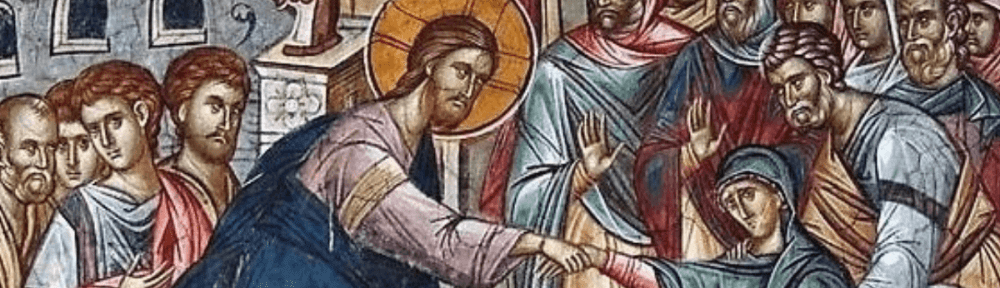
Image credit: Monastery Decani, South Wall, Christ’s Miracles (59) – Christ heals Peter’s Mother in Law | PD-US
Discover more from friarmusings
Subscribe to get the latest posts sent to your email.
 friarmusings