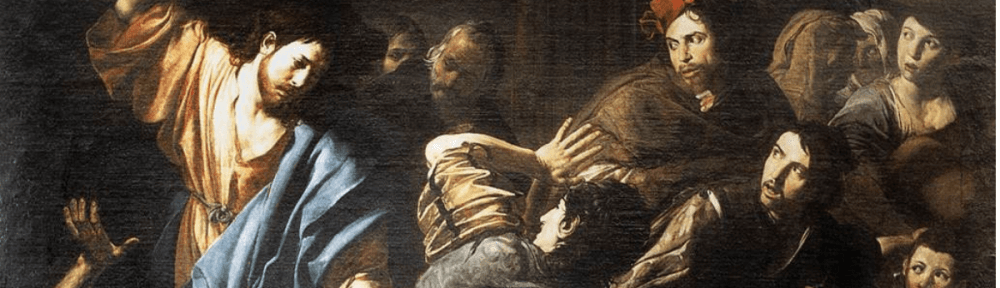
This coming Sunday is the 3rd Sunday in Lent, Lectionary Cycle B. The temple narrative in John consists of two parts: Jesus’ actions in the Temple (vv. 14–17):
14 He found in the temple area those who sold oxen, sheep, and doves, as well as the money-changers seated there. 15 He made a whip out of cords and drove them all out of the temple area, with the sheep and oxen, and spilled the coins of the money-changers and overturned their tables, 16 and to those who sold doves he said, “Take these out of here, and stop making my Father’s house a marketplace.” 17 His disciples recalled the words of scripture, “Zeal for your house will consume me.”
and Jesus’ saying about the destruction of the Temple (vv. 18–22):
18 At this the Jews answered and said to him, “What sign can you show us for doing this?” 19 Jesus answered and said to them, “Destroy this temple and in three days I will raise it up.” 20 The Jews said, “This temple has been under construction for forty-six years, and you will raise it up in three days?” 21 But he was speaking about the temple of his body. 22 Therefore, when he was raised from the dead, his disciples remembered that he had said this, and they came to believe the scripture and the word Jesus had spoken.
The temple narrative is set at Passover (v. 13); the expression “the Passover of the Jews” would seem to either be a formal description or a subtle distancing of the Fourth Evangelist and his community from the religious observances of the Jewish community.
The other gospels each have an account of a cleansing of the Temple (Matt. 21:12–13; Mark 11:15–17; Luke 19:45–46). The Markan account is the fullest, but even so it is shorter than John’s. John differs from Mark in mentioning oxen and sheep, the scourge of cords, the word for “money changers” (v. 14), the “spilling” of the money and the command, “Take these out of here.” John’s word for “overturned” is different from that in any of the Synoptic gospels, and whereas they say that Jesus quoted Isaiah 56:7 followed by Jeremiah 7:11, John does not speak of him as citing any Scripture. But he does say that the disciples remembered Psalm 69:9, which none of the other gospels record. He does not mention, as Mark does, Jesus’ prohibition of carrying anything through the Temple (Mark 11:16; seemingly “don’t make the Temple a shortcut to somewhere else”). Mark says that Jesus overturned the seats of the sellers of doves, John only that he told them to take “these” things away. But the most important difference is one of time. In this Gospel the cleansing of the Temple is the first great public act of Jesus’ ministry; in the other Gospels it is among the last associated with his passion.
Many believe it is unlikely that Jesus performed this bold act twice, so the two traditions probably narrate the same event. The synoptic chronology is thought to be the more historically reliable, because it is difficult to see how the Jewish religious authorities would have tolerated such a confrontational act at the beginning of Jesus’ ministry. That being said it could also be argued that the practices in question were ones that were likely to have restarted soon after Jesus’ action thus there was not a permanent end to the practices. Perhaps, the act was indeed repeated several years later.
Assuming there was only one occurrence, the later cleansing of the Temple was moved by St. John to the beginning of his Gospel because it serves a symbolic function for him.
Image credit: Christ Driving the Money Changers out of the Temple by Valentin (1618) | Galleria Nazionale d’Arte Antica, Rome | PD-US
Discover more from friarmusings
Subscribe to get the latest posts sent to your email.
 friarmusings