This coming Sunday is the 3rd Sunday in Lent. The temple cleansing in John completes the inaugural event begun with the Cana miracle. John 2:1–11 revealed the grace and glory of Jesus and the abundant new life Jesus offers. John 2:13–22 highlights the challenge and threat that new life poses to the existing order (cf. John 5:1–18).
From the beginning of the Fourth Gospel there has been a theme of newness and of creation. The Prologue refers to the power and role of the Word of God in the story of Creation. Then, very subtly, it continues to recount a new creation in the Incarnation of Jesus. In John 1:29 you see the phrase, “the next day” as John the Baptist testified to Jesus. “The next day” the first apostles are called in v.34 and following. The “next day” (v.43), now day four of the new creation week, Philip and Nathanael are added as disciples.
The passage immediately before our gospel passage in the Wedding at Cana (John 2:1-11). Our gospel is followed by the account of Jesus and Nicodemus (John 3:1-21). “On the third day…” (Jn 2:1) we find ourselves, according to the Johannine imagery, on the seventh day of the new creation week. The creation week reaches its climax – the unveiling of the public life of the Anointed One of God. The account of the wedding at Cana is relatively short (11 verses) and yet it is filled with a variety of images, theological and sacramental.
It may be significant for St John that the wedding feast account occurs on the 3rd/7th day. In Nb 19 these are the days on which the ritually impure were sprinkled with water so that they were (a) rejoined to the people of Israel and (b) could re-enter the Temple. Without this rite of purification they were cut off from chosen people of God. This view is supported when in Jn 2:6 we are told that the six stone jars were for the Jewish rites of purification. But what purification is needed here? I believe that St John is connecting this event to the baptism of John. That baptism was a call of repentance to Israel as a means of purifying themselves for the arrival of the Consolation of Israel; for a new covenantal relationship with God.
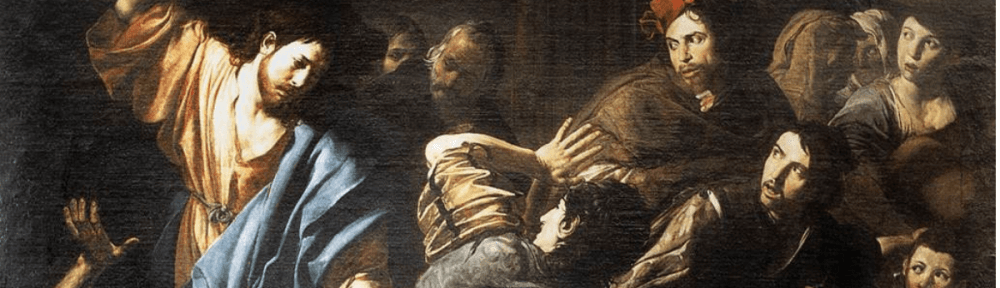
All of these Johannine accounts speak of newness, renewal, or creation – the cleansing of the Temple is a part of this thread. This physical purification of the temple might remind us of the type of symbolic deeds acted out by the prophets; and, indeed, Jesus’ approach to the temple on this occasion resembles that of Jeremiah (Jer 7). The action, though not a miracle, is a sign, a double sign. The temple, soon to be destroyed, stood in need of purification. And its function would be replaced by the risen body of Christ.
Image credit: Christ Driving the Money Changers out of the Temple by Valentin (1618) | Galleria Nazionale d’Arte Antica, Rome | PD-US
Discover more from friarmusings
Subscribe to get the latest posts sent to your email.
 friarmusings