This coming Sunday is the 4th Sunday in Lent in Lectionary Cycle B. Our gospel selection is akin to walking into the middle of a conversation – and indeed it is. Although Nicodemus has faded from the scene, at least by mention and name, this gospel is part of that dialogue between Jesus and Nicodemus, one of the leaders of the Jews. John 3:1-21 is often taken as a single pericope by scholars, that is, studied and considered together.
So, what have we missed in the on-going conversation? Nicodemus, a Jewish leader (v. 1), seeks out Jesus. To seek Jesus, as noted earlier (1:38), is one of the first acts of discipleship in John. On the negative side, however, Nicodemus hides his seeking under the cloak of night (cf. the night visit of King Zedekiah and Jeremiah, Jer 37:16-21). This reference to the time of Nicodemus’s visit is neither an incidental detail nor an attempt at historical reporting. Rather, it provides a clue to the significance of this story for the Fourth Evangelist. “Night” (nyktos) is used metaphorically in the Fourth Gospel to represent separation from the presence of God (John 9:4; 11:10; 13:30). The symbolic significance of this night visit is confirmed by 3:19-21, which condemns those who prefer darkness to light.
Perhaps Nicodemus was intrigued by Jesus’ cleansing of the vendors and money changers from the Temple; perhaps he wondered if Jesus was the long-promised Messiah. Whatever the reason, Nicodemus sensed this was a man of God: “Rabbi, we know that you are a teacher who has come from God, for no one can do these signs that you are doing unless God is with him.” (v.2)
A dialogue ensues about entering into the Kingdom of God; it is animated by ambiguity and misunderstanding. Jesus tells him that entrance into the “kingdom” depends on being reborn through “water and Spirit” (v.5), which is a birth “from above” (v.3). The original Greek at this point can mean either “from above” or “again” (see notes below). The double meaning is intentional and becomes a choice for Nicodemus who can choose to think of Jesus and the kingdom in either earthly terms or in heavenly terms. Nicodemus focuses on being born again in earthly terms rather than being born from above.
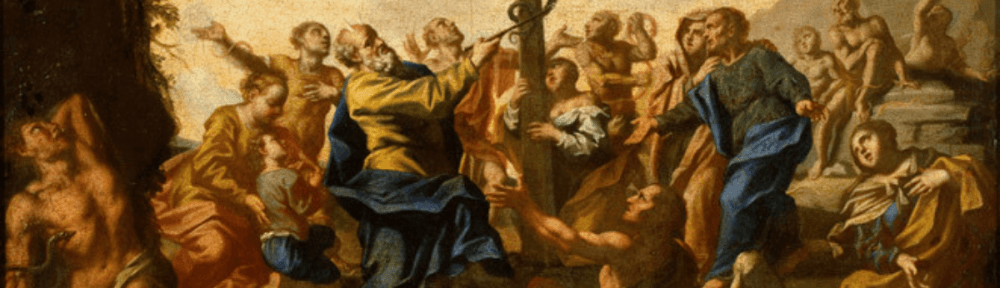
What begins as a dialogue in verses 1–10 turns into a monologue in verses 11–15 as Nicodemus seems to disappear into the darkness from which he came: 11 Amen, amen, I say to you, we speak of what we know and we testify to what we have seen, but you people do not accept our testimony. 12 If I tell you about earthly things and you do not believe, how will you believe if I tell you about heavenly things? 13 No one has gone up to heaven except the one who has come down from heaven, the Son of Man. 14 And just as Moses lifted up the serpent in the desert, so must the Son of Man be lifted up, 15 so that everyone who believes in him may have eternal life.”
Image credit: Moses and the Bronze Serpent by Francesco Campora, 18th Century | Museu Nacional de Belas Artes, Rio de Janeiro | PD-US
Discover more from friarmusings
Subscribe to get the latest posts sent to your email.
 friarmusings