This coming Sunday is the 4th Sunday in Lent. With the dialogue with Nicodemus over, the verses become a monologue by Jesus in which he makes a reference to a well known story from the Book of Numbers – well known to the first century audience, but perhaps not to you. The setting for the reference is that the tribes have transited the wilderness and are near the Promised Land. Moses sends out 12 spies to reconnoiter the land. Ten return giving reports of dire warning and the message to turn back. Two recognize the peril but also note the fertility of the land – and point out that God is ever on their side. The people turn back, condemned to wander in the wilderness and the grumbling begins (actually continues!):
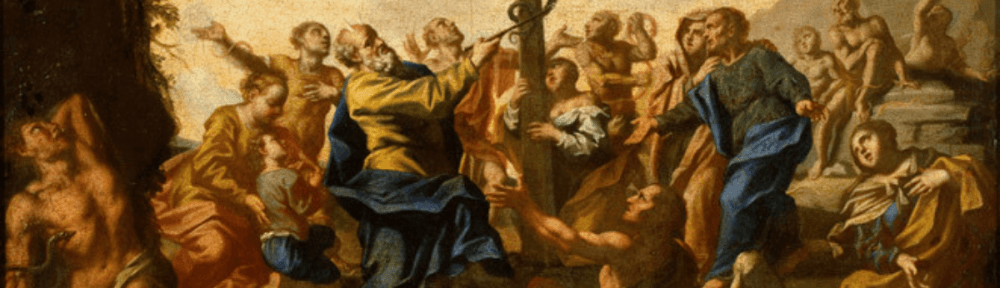
With their patience worn out by the journey, the people complained against God and Moses, “Why have you brought us up from Egypt to die in this desert, where there is no food or water? We are disgusted with this wretched food!” In punishment the LORD sent among the people saraph serpents, which bit the people so that many of them died. Then the people came to Moses and said, “We have sinned in complaining against the LORD and you. Pray the LORD to take the serpents from us.” So Moses prayed for the people, and the LORD said to Moses, “Make a saraph and mount it on a pole, and if any who have been bitten look at it, they will live.” Moses accordingly made a bronze serpent and mounted it on a pole, and whenever anyone who had been bitten by a serpent looked at the bronze serpent, he lived. (Numbers 21:4-9)
In previous times complaints about food had brought a divine supply of their needs (11:4–35), but now the response of God is to send a scourge of fiery serpents that kills many people. Again as before, the Israelites repent (11:2; 12:11; 14:40) and ask Moses to intercede with Yahweh (11:2; 12:11–13). When he does, God instructs him to construct a copper image of one of the lethal snakes and to set it on a pole where it can be seen. No one is saved from being bitten, but if one is bitten and chooses to obey God by looking at the copper snake, one will be cured from the lethal effects of the bite.
There is much speculation about the snake (“fiery” likely because of the burning associated with its bite) and why mounting a copper image of it is the means of cure. There is no firm agreement, but here is at least one interesting speculation. The people were “threatening” to return to Egypt, turning away from God towards evil. The Egyptian god Apep (also Apophasis) was the evil god who lost in battle to the sun god Re; his rival Apep was the god of death, darkness and an opponent of light – and interestingly, was also the god of medicine and healing. But there was one catch: worshippers were not to look upon the snake god. To raise their eyes and look on the snake was to receive the judgment of death from Apep and know eternal darkness. To keep one’s eyes cast down in worship was to know healing.
The command from Moses for those who had been bitten – and presumably guilty of turning away from God – was to look upon their snake god. They were facing certain death from the snake bit and knew that only the true God would save them. If they had faith in Lord and looked upon the image of god who was no god at all, they were healed: “anyone who had been bitten by a serpent looked at the bronze serpent, he lived.” If they refused to admit their guilt and kept their eyes cast downward in false worship, then they died, ironically suffering the very opposite fate that their former worship promised.
Image credit: Moses and the Bronze Serpent by Francesco Campora, 18th Century | Museu Nacional de Belas Artes, Rio de Janeiro | PD-US
Discover more from friarmusings
Subscribe to get the latest posts sent to your email.
 friarmusings