This coming Sunday is the 4th Sunday in Lent. For God so loved the world that he gave his only Son, so that everyone who believes in him might not perish but might have eternal life. Verse 16 provides the link between the two parts of the discourse. It sums up vv. 14-15 by reiterating the salvific dimensions of Jesus’ death, but moves the argument forward with its reference to God’s love. God gave Jesus to the world because God loves the world.
A first century Jew was ready enough to think of God as loving Israel, but no passage appears to be cited in which any Jewish writer maintains that God loved the world. It is a distinctively Christian idea that God’s love is wide enough to embrace all people. His love is not confined to any national group or spiritual elite. It is a love that proceeds from the fact that He is love (1 John 4:8, 16). It is his nature to love. He loves people because he is the kind of God he is. John tells us that his love is shown in the gift of his Son. [Morris, 203]
The verb translated “give” (didōmi) is regularly used in the Fourth Gospel to describe God as the source of what Jesus offers the world (3:35; 5:22, 26, 36). John 3:16 is the only place in the Fourth Gospel that says God “gave” his Son to the world; the more common expression is that God “sent” Jesus, as in 3:17. (Two Greek verbs meaning “to send” pempō and apostellō are used interchangeably in Johannine passages) “Send” Jesus is more clearly associated with will for the world, whereas didōmi seems to be used in 3:16 to underscore that the incarnation derives from God’s love for the world as well as from God’s will.
“World” (kosmos) in John refers often to those human beings who are at odds with Jesus and God (1:10, 7:7; 15:18-19). The use of the term here suggests that God gives Jesus in love to all people, but only believers accept the gift. Verse 16 also reiterates the theme of eternal life from v. 15, but advances the argument by naming the alternative to eternal life: to perish. This verse makes clear that there is no middle ground in the Johannine vision. God’s gift of Jesus, which culminates in Jesus’ death, resurrection, and ascension, decisively alters the options available to the world. If one believes, one’s present is altered by the gift of eternal life; if one does not believe, one perishes.
Judgment. 17 For God did not send his Son into the world to condemn the world, but that the world might be saved through him. God did not send the Son into the world, he tells us, in order to judge it. Elsewhere, however, he says that Jesus did come into the world “for judgment” (9:39). The resolution of the paradox demands that we understand salvation as necessarily implying judgment. These are the two sides to the one coin. Jesus came to bring salvation, but the very fact of salvation for all who believe implies judgment on all who do not. This is a solemn reality, and John does not want us to escape it. Judgment was a recognized theme in contemporary Jewish thought, but it is the judgment of God, and it is thought of as taking place at the last day. John modifies both these thoughts. He does, it is true, speak of judging sometimes in much the normal Jewish way (8:50). But it is quite another matter when he says that God has committed all judgment to Christ (5:22, 27). He goes on to speak of Christ as judging (5:30; 8:16, 26) or not judging (8:15 [but cf. 16]; 12:47), and of his word as judging people (12:48). His judgment is just (5:30) and true (8:16). How people will fare in the judgment depends on their relationship to him (5:24; 3:19). As the cross looms large Jesus can even speak of the world as judged (12:31), and of Satan likewise as judged (12:31; 16:11). Clearly John sees the whole traditional doctrine of judgment as radically modified in the light of the incarnation. The life and especially the death of Jesus have their effects on the judgment. [Morris, 205]
God’s gift of Jesus to the world begins the judgment of the world. Verses 17-21 speak of realized eschatology, meaning that God’s judgment of the world is not a cosmic future event but is underway in the present, initiated by Jesus’ coming into the world. God sends the Son into the world in love in order to save the world, not condemn it (v. 17). Yet the very presence of Jesus as incarnate Word in the world confronts the world with a decision, to believe or not to believe, and making that decision is the moment of judgment. If one believes, one is saved; if one does not believe, one condemns oneself unwittingly: Whoever believes in him will not be condemned, but whoever does not believe has already been condemned, because he has not believed in the name of the only Son of God (v.18)
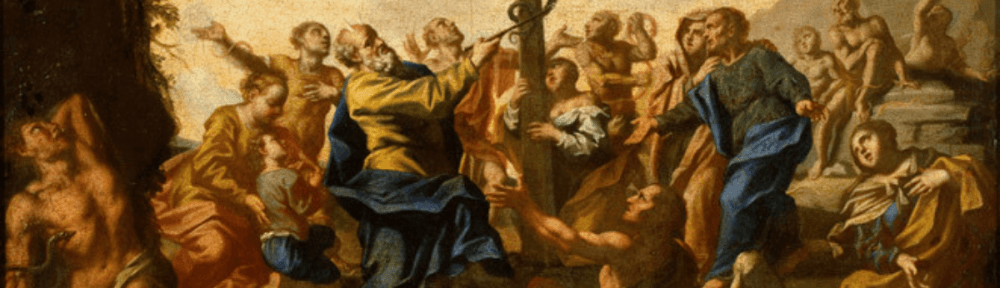
Image credit: Moses and the Bronze Serpent by Francesco Campora, 18th Century | Museu Nacional de Belas Artes, Rio de Janeiro | PD-US
Discover more from friarmusings
Subscribe to get the latest posts sent to your email.
 friarmusings