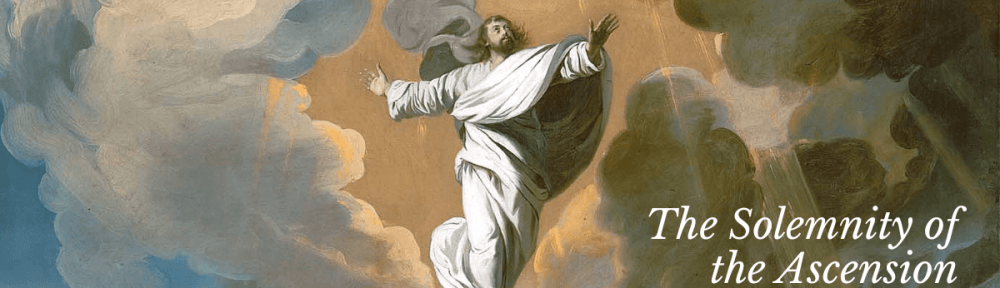
This coming Sunday in the Solemnity of the Ascension taken from the Gospel of Mark (Lectionary Cycle B). The Ascension of Jesus celebrates the Christian belief of the bodily Ascension of Jesus into Heaven. Based on the account of Acts 1:3 that the risen Jesus appeared to his disciples for 40 days after the Resurrection: “He presented himself alive to them by many proofs after he had suffered, appearing to them during forty days and speaking about the kingdom of God.” After these days, we read that Jesus was taken up to heaven.
“‘But you will receive power when the holy Spirit comes upon you,g and you will be my witnesses in Jerusalem, throughout Judea and Samaria, and to the ends of the earth.’ When he had said this, as they were looking on, he was lifted up, and a cloud took him from their sight.” (Acts 1:8-9) or
“As he blessed them he parted from them and was taken up to heaven.” (Luke 24:51)
John’s Gospel has three references to Ascension in Jesus’ own words: “No one has gone up to heaven except the one who has come down from heaven, the Son of Man.” (John 3:13); What if you [the disciples] were to see the Son of Man ascending where he was before?” (John 6:62); and to Mary Magdalene after his resurrection, “Do not hold me, for I have not yet ascended to my Father…” (John 20:17).
The Gospel of Matthew does not record the account of the Ascension. The Gospel of Mark mentions the Ascension in the “longer ending” … we’ll explain that later on.
The observance of this feast is of great antiquity. Eusebius seems to hint at the celebration of it in the 4th century. At the beginning of the 5th century, Augustine of Hippo says that it is of Apostolic origin, and he speaks of it in a way that shows it was the universal observance of the Catholic Church long before his time. Frequent mention of it is made in the writings of John Chrysostom, Gregory of Nyssa, and in the Constitution of the Apostles.
The traditional celebration of the Solemnity of the Ascension, 40 days after Easter Sunday, falls on a Thursday, which for centuries was the celebrated feast throughout Christendom. Even as early as the 6th century there are annals that complain people were sometimes keeping the holy day of the Ascension but not Pentecost and vice-versa. In modern times more and more people were not celebrating the Solemnity of the Ascension. As allowed by Canon 1260 of the law of the Church, in 1992 the US Bishops petitioned the Vatican to move the Solemnity of the Ascension to the 7th Sunday of Easter to allow more people to celebrate it. The petition was granted, leaving the final decision to the local bishop. In the diocese of Arlington, the Bishop has transferred the Solemnity of the Ascension to the 7th Sunday after Easter. The Gospel reading for the Ascension in Lectionary Cycle B is taken from the end of the Gospel of Mark.
Now… what is the meaning of the “longer ending” in the Gospel of Mark?
Credit image: detail from “The Ascension” (1775) by John Singleton Copley | Museum of Fine Arts, Boston | PD-US
Discover more from friarmusings
Subscribe to get the latest posts sent to your email.
 friarmusings