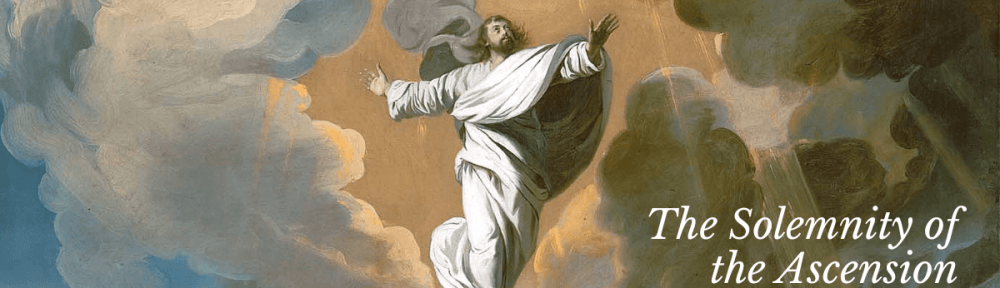
This coming Sunday in the Solemnity of the Ascension taken from the Gospel of Mark. The title might strike you as an odd entry, but the gospel of Mark has several “endings.” That probably needs some explanation. In the paragraphs that follow we will briefly discuss the different endings.
- The original/early ending,
- The longer ending,
- The shorter ending,
- The Freer logion.
The original/early ending:
In the earliest known versions of the Markan text (Vaticanus, Sinaiticus, Old Latin MS k, Sinaitic Syriac, and other equally old versions), the gospel ends with v.8 – a rather abrupt ending.
5 On entering the tomb they [the women] saw a young man sitting on the right side, clothed in a white robe, and they were utterly amazed. 6 He said to them, “Do not be amazed! You seek Jesus of Nazareth, the crucified. He has been raised; he is not here. Behold the place where they laid him. 7 But go and tell his disciples and Peter, ‘He is going before you to Galilee; there you will see him, as he told you.’” 8 Then they went out and fled from the tomb, seized with trembling and bewilderment. They said nothing to anyone, for they were afraid.
We never find out the rest of the Easter Sunday story.
Writing in the 4th century the church historian Eusebius remarked that “accurate” copies of Mark ended with verse 8. St. Jerome, translator of the Bible into Latin, echoes this testimony when he says of the last twelve verses of Mark that “almost all the Greek codices do not have this concluding portion.” But then again not all copies of the Gospel of Mark were known to Jerome. Verses 9-20 are found in some less important manuscripts, has traditionally been accepted as a canonical part of the gospel and was defined as such by the Council of Trent. Early citations of those later verses by the early Church Fathers indicate that it was composed by the second century, although vocabulary and style indicate that it was likely written by someone other than Mark.
The longer ending: following v. 8 is found in almost all modern bibles:
“9 When he had risen, early on the first day of the week, he appeared first to Mary Magdalene, out of whom he had driven seven demons. She went and told his companions who were mourning and weeping. When they heard that he was alive and had been seen by her, they did not believe. After this he appeared in another form to two of them walking along on their way to the country. They returned and told the others; but they did not believe them either. [But] later, as the eleven were at table, he appeared to them and rebuked them for their unbelief and hardness of heart because they had not believed those who saw him after he had been raised. He said to them, “Go into the whole world and proclaim the gospel to every creature. Whoever believes and is baptized will be saved; whoever does not believe will be condemned. These signs will accompany those who believe: in my name they will drive out demons, they will speak new languages. They will pick up serpents [with their hands], and if they drink any deadly thing, it will not harm them. They will lay hands on the sick, and they will recover. So then the Lord Jesus, after he spoke to them, was taken up into heaven and took his seat at the right hand of God. But they went forth and preached everywhere, while the Lord worked with them and confirmed the word through accompanying signs.” (Mark 16:9-20)
The so-called “longer ending” is part of the Canon of Scripture which appears in a wide variety of ancient copies that date from the early to mid-second century. Scholars believe that the text was part of an early church kerygma text, taken in whole, from a liturgy and added to round out the ending of Mark’s gospel. Such a theory does explain why in v.8 the subject of the verse is the women and suddenly in v.9 the subject is masculine and easily assumed to be Jesus.
Credit image: detail from “The Ascension” (1775) by John Singleton Copley | Museum of Fine Arts, Boston | PD-US
Discover more from friarmusings
Subscribe to get the latest posts sent to your email.
 friarmusings