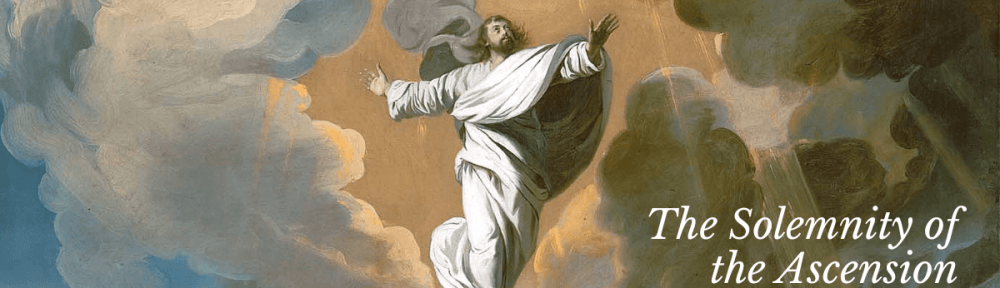
This coming Sunday in the Solemnity of the Ascension taken from the Gospel of Mark. Although virtually all of today’s scholars of the Bible believe that Mark had a purpose in ending his Gospel abruptly at 16:8, this was not always the case. Some first- or second-century Christians tried to “complete” his Gospel drama by adding scenes that they thought Mark should have added himself.
The first extra ending, the so-called Longer Ending (vv. 9–20), includes appearances of the risen Jesus to Mary Magdalene and to the disciples. These visions were meant to inspire the early missionary church to “go into the whole world and proclaim the gospel to every creature” (v. 15). The church’s missionaries had nothing to fear, because the ascended Lord (v. 19) was with them in their preaching (v. 20) and would confirm their message with special signs of his protection and power (vv. 17–18). Alert readers will notice some themes in these verses that are unlike anything they have seen before in Mark’s Gospel. They may also recognize in them echoes of familiar scenes from the other Gospels, gathered together to round off Mark’s abrupt ending (for example, Mary Magdalene meets with Jesus alone in John’s Gospel, 20:11–18; the appearance to the two disciples is reminiscent of Luke’s Emmaus appearance, 24:13–35; and the commission to “go into the whole world to preach” sounds like the ending of Matthew’s Gospel, 28:16–20).
The so-called Shorter Ending, when read immediately after 16:8, was another attempt of the early church to end Mark’s Gospel more smoothly. It reverses the fear and silence of the women at the tomb and shows how the message of the resurrection came to be proclaimed through “Peter’s companions.”
The Freer Ending, preserved in the Freer Gallery in Washington, D.C., is a fifth-century addition to the Longer Ending. Appearing between verses 14 and 15, it excuses the disbelief and stubbornness of the disciples found at 16:14. Although the church has noted these “added endings” one thing that can be said of the “original” is that Mark’s abrupt ending leaves it up to his readers to “complete” his Gospel in their lives.
Credit image: detail from “The Ascension” (1775) by John Singleton Copley | Museum of Fine Arts, Boston | PD-US
Discover more from friarmusings
Subscribe to get the latest posts sent to your email.
 friarmusings