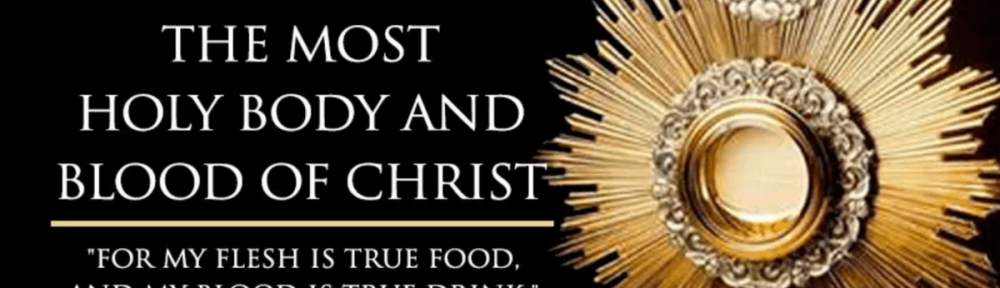
This coming Sunday, The Solemnity of the Most Holy Body and Blood of Christ. One of the reasons to “study” Scripture is to realize the gospels are not newspaper reports, historic documentation (although it sometimes does just that), or even eye-witness accounts. Most often the gospels are the writing down, under divine inspiration, the oral accounts of the early Christian community about Jesus the Christ. This is worth noting because, when asked about the Last Supper, most Christians will reply that it was the traditional Passover meal, referencing the opening verse of our gospel: “On the first day of the Feast of Unleavened Bread, when they sacrificed the Passover lamb, his disciples said to him, “Where do you want us to go and prepare for you to eat the Passover?” (Mark 14:12) Yet this verse gives us a somewhat ambiguous “time stamp.” William L. Lane, William (The Gospel of Mark) offers an interesting analysis of this ambiguity which is included in what follows.
The phrase first day of the Feast of Unleavened Bread ordinarily denotes the 15th of Nisan that comes after the celebration of the Passover the previous evening. Yet, there is some evidence in the rabbinical literature, however, that the day on which the paschal lambs were sacrificed (the 14th of Nisan) was sometimes loosely designated “the first day of Unleavened Bread.” This gospel was written some 40 years after the death of Jesus and so, despite the ambiguity, the important “time stamp” is the reference to the slaughter of the passover lambs on the afternoon of Nisan 14, clearly implying that the meal which Jesus celebrated with his disciples was the Passover and that the day of his arrest, condemnation and crucifixion was the 15th of Nisan.
Why mention this? In the world of gospel scholarship it has been noted that the Gospel according to John seems to situate Jesus’ death in the framework of the preparation for the Passover on the 14th of Nisan (John 18:28; 19:14, 31, 42), which would mean that the meal could not have been the Passover. That being said, the Gospel of John is dated some 20-30 years after the Gospel of Mark.
There are a number of positive elements in the Marcan narrative which substantiate that the Last Supper was a Passover meal. The return to Jerusalem in the evening for the meal (Ch. 14:17) is significant, for the paschal meal had to be eaten within the city walls (Mishnah Pesachim VII. 9). An ordinary meal was taken in the late afternoon, but a meal which begins in the evening and continues into the night reflects Passover practice (Exod. 12:8; Jubilees 49:12). The reference to reclining (Ch. 14:18) satisfies a requirement of the Passover feast in the first century when custom demanded that even the poorest man recline for the festive meal (Mishnah Pesachim X. 1). While a normal meal began with the breaking of bread, on this occasion Jesus broke the bread during the meal and followed the serving of a dish (Ch. 14:18–20, 22). The Passover meal was the one occasion when the serving of a dish preceded the breaking of bread. The use of wine was generally reserved for festive occasions and was characteristic of the Passover (Mishnah Pesachim X. 1). Finally, the interpretation of the elements of the meal conforms to Passover custom where the haggadah (or interpretation) is an integral part of the meal. The cumulative evidence supports the claim made in verses 12, 14 and 16 that the disciples prepared a Passover meal and that the external forms of the Passover were observed at the meal itself.
There are indications that the Fourth Evangelist also regarded the meal which Jesus shared with his disciples as a Passover. The feast takes place within Jerusalem even though the city was thronged with pilgrims (John 12:12, 18, 20; 13:2; 18:1; cf. Mark 14:17). The supper is held in the evening and lasts into the night (John 13:30; cf. Mark 14:17). The meal was ceremonial in character and the participants reclined at table (John 13:12, 23, 25, 28; cf. Mark 14:18). Finally, the walk to Gethsemane followed by the betrayal conforms to the Marcan sequence of events (John 18:1ff.; Mark 14:26ff.). In this light it seems that the concern of the priests expressed in John 18:28, that they should not become defiled and so be prohibited from eating “the pesach,” has reference not to the paschal lamb (which would have been eaten the evening before) but to the chagigah, the paschal sacrifices (lambs, kids, bulls) which were offered throughout the festival week. These paschal sacrifices are designated by the term pesach in Deut. 16:2 and 2 Chron. 35:7. If this understanding informed the tradition John has transmitted, the apparent contradiction with the evidence of Mark is removed.
Image credit: Pexels modified with Canva, CC-0
Discover more from friarmusings
Subscribe to get the latest posts sent to your email.
 friarmusings