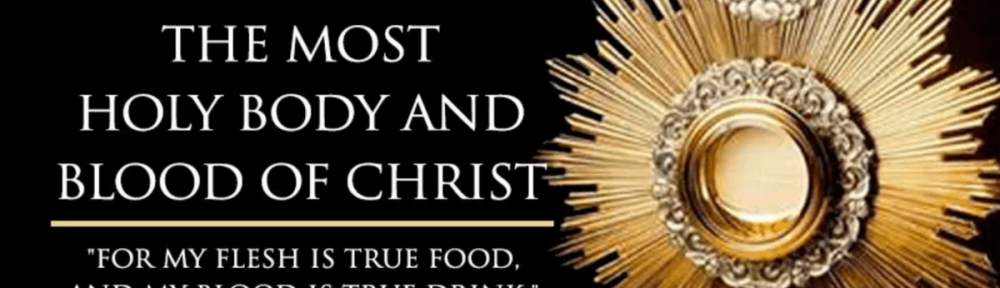
This coming Sunday, The Solemnity of the Most Holy Body and Blood of Christ. The interpretation of detailed elements in the meal was a fixed part of the Passover liturgy conducted by the head of the household. This occurred after the meal had been served but before it was eaten. When Jesus lifted the platter of unleavened bread he may be presumed to have spoken the Aramaic formula prescribed in the liturgy: “This is the bread of affliction which our fathers ate in the land of Egypt. Let everyone who hungers come and eat; let everyone who is needy come and eat the Passover meal.” Each of the other elements was also introduced in the context of Israel’s experience in bondage. The bitter herbs served to recall the bitterness of slavery, the stewed fruit, which possessed the consistency and color of clay, evoked the making of bricks as slaves, while the paschal lamb provided a reminder of God’s gracious “passing over” of Israel in the plague of death that came to Egypt. While the wording of Jesus’ paschal devotions has not been preserved, it is evident that the disciples were prepared for understanding the significance of the words of institution preserved in verses 22–24 by the manner in which Jesus interpreted the components of the meal.
The blessing of God for the gift of bread immediately preceded the meal itself. The head of the family sat up from his reclining position, took a cake of unleavened bread, and recited the blessing over it in the name of all: “Praised be Thou, O Lord, Sovereign of the world, who causes bread to come forth from the earth” (Mishnah Berachoth VI. 1). Those present identified themselves with the blessing by saying “Amen.” The family-head then broke for each person present a piece and gave it to him, the bread passing from hand to hand until it reached all the guests. The distribution normally took place in silence, for the explanation of the elements belonged to the Passover devotions, not to the grace before the meal. Contrary to paschal custom, Jesus broke the silence by interpreting the significance of the bread in terms of his own person. While they were eating, he took bread, said the blessing, broke it, and gave it to them, and said, “Take it; this is my body.” (Mark 14:22)
Interpreting the significance of the bread and wine varies by denomination. What is clear is that in the Catholic tradition. As described in the Catechism of the Catholic Church §1323: “At the Last Supper, on the night he was betrayed, our Savior instituted the Eucharistic sacrifice of his Body and Blood. This he did in order to perpetuate the sacrifice of the cross throughout the ages until he should come again, and so to entrust to his beloved Spouse, the Church, a memorial of his death and resurrection: a sacrament of love, a sign of unity, a bond of charity, a Paschal banquet ‘in which Christ is consumed, the mind is filled with grace, and a pledge of future glory is given to us.” (original in Lumen Gentium 11). This is the language of covenant.
Following the main meal (cf. 1 Cor. 11:25) of the Passover, the head of the household rose again from his reclining position and exhorted those present to “Speak praises to our God, to whom belongs what we have eaten,” to which those present replied, “Praised be our God for the food we have eaten.” With his right hand he then took the third cup of red wine mixed with water, and with his eyes on the cup pronounced the prayer of thanksgiving on behalf of all, with the concluding words: “May the All-merciful One make us worthy of the days of the Messiah and of the life of the world to come. He brings the salvation of his king. He shows covenant-faithfulness to his Anointed, to David and to his seed forever. He makes peace in his heavenly places. May he secure peace for us and for all Israel. And say you, Amen.” After the company had affirmed their participation in the blessing with their “Amen,” Jesus passed the common cup from which all were to drink, and spoke the second word of institution. Then he took a cup, gave thanks, and gave it to them, and they all drank from it. 24 He said to them, “This is my blood of the covenant, which will be shed for many. (Mk 14:23-24)
Jesus’ saying relates the cup with the red wine to the renewal of the covenant between God and his people. The primary reference here is to Jesus’ blood shed in the context of covenant sacrifice. The reference to the covenant established in Jesus’ blood contains an allusion to Exod. 24:6–8, where the old covenant at Sinai was ratified by the sprinkling of sacrificial blood, and serves to set the whole of Jesus’ messianic action in the light of covenant renewal. It also evokes Jer. 31:31–33 where God promises to establish a new covenant with his people in the last days. That promise is now sealed through Jesus’ action and the death it anticipates.
The saying over the cup directs attention to Jesus as the one who fulfills the divine will to enter into covenant fellowship with his people on a new and enduring basis. The latter part of the saying explains the vicarious character of Jesus’ death in terms of Isa. 53:12 and calls to mind the similar formulation of Mk 10:45. The “many” are the redeemed community who have experienced the remission of their sins in and through Jesus’ sacrifice and so are enabled to participate in the salvation provided under the new covenant. Jesus’ second gift to his disciples, then, is the assurance that he will be with them as their Savior who establishes the new order through his death. He freely yields his life in order that God’s will to save his people may be affected. By his prophetic action in interpreting these familiar parts of the ancient paschal liturgy Jesus instituted something new in which the bread and wine become the pledge of his real presence throughout time.
Image credit: Pexels modified with Canva, CC-0
Discover more from friarmusings
Subscribe to get the latest posts sent to your email.
 friarmusings
His body and blood . . . saying you are grateful doesn’t sound sufficient or adequate. I am very grateful for his sacrifice so many years ago! Thank you, Father George!