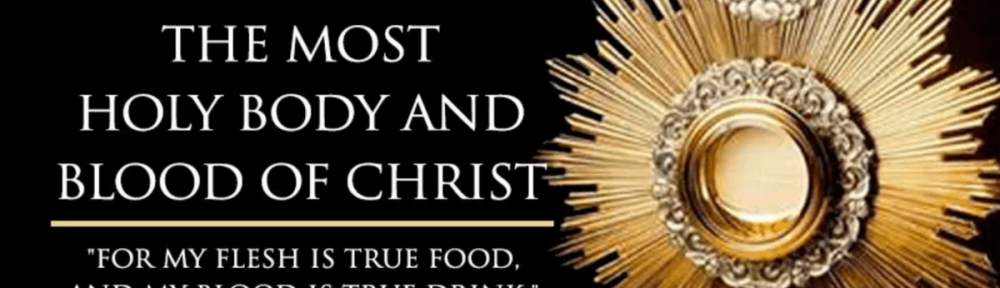
This coming Sunday, The Solemnity of the Most Holy Body and Blood of Christ. Jesus’ words of promise were confirmed with a solemn oath that he would not share the cup until the meal was resumed and completed in the consummation: “Amen, I say to you, I shall not drink again the fruit of the vine until the day when I drink it new in the kingdom of God.” (Mark 14:25) The sober reference “not .. again” indicates that this is Jesus’ final meal and adds a sense of a farewell.
The purpose of his vow of abstinence was to declare that his decision to submit to the will of God in vicarious suffering was irrevocable. Forswearing feasting and wine, Jesus dedicated himself with a resolute will to accept the bitter cup of wrath offered to him by the Father. Yet there is here a clear anticipation of the messianic banquet when the Passover fellowship with his followers will be renewed in the Kingdom of God. Then Jesus will drink the wine “new,” where in this context newness is the mark of the redeemed world and the time of ultimate redemption. The reference to “the day” envisions the parousia and the triumph of the Son of Man (Mark 13:24–27, 32; cf. 1 Cor. 11:26). Thus in the context of reflecting upon his violent death on behalf of the many, and just prior to the impending events of the passion, Jesus clearly affirmed his vindication and the establishment of an uninterrupted fellowship between the redeemed community and its Redeemer through the experience of messianic salvation.
The cup from which Jesus abstained was the fourth, which ordinarily concluded the Passover meal. The significance of this can be appreciated from the fact that the four cups of wine were interpreted in terms of the four-fold promise of redemption set forth in Exod. 6:6–7: “I will bring you out … I will rid you of their bondage … I will redeem you … I will take you for my people and I will be your God” (Jerusalem Talmud Pesachim X. 37b). Jesus had used the third cup, associated with the promise of redemption, to refer to his atoning death on behalf of the elect community. The cup which he refused was the cup of consummation, associated with the promise that God will take his people to be with him. This is the cup which Jesus will drink with his own in the messianic banquet which inaugurates the saving age to come. The cup of redemption (v.24), strengthened by the vow of abstinence (v.25), constitutes the solemn pledge that the fourth cup will be extended and the unfinished meal completed in the consummation, when Messiah eats with redeemed sinners in the Kingdom of God (cf. Lk. 14:15; Rev. 3:20f.; 19:6–9).
Note: Dr. Scott Hahn, a Catholic exegete, integrating this insight to all the gospel texts as a fuller story and citing the account from John where Jesus takes the bitter wine on the cross, concludes that the “cup of consummation” (4th cup) was taken from the cross. There the fulfillment of the 3rd cup was enacted upon the cross when “blood was spilled” enacting the Covenant with God that again “we” are his people and He is our God.
A Transition into the Night
Among devout Jews it was common to remain together at the table for several hours after the conclusion of the meal, deep in conversation about God’s past and future acts of redemption (Tosephta Kethubim V. 5). The table-fellowship was concluded by the recitation of the second half of the Hallel Psalms. It was customary to sing the Hallel antiphonally, one member of the table company chanting the text, and the others responding to each half verse with the shout of praise, “Hallelujah.” Jesus took the words of these psalms as his own prayer of thanksgiving and praise. He pledged to keep his vows in the presence of all the people (Ps. 116:12–19); he called upon the Gentiles to join in the praise of God (Ps. 117); and he concluded with a song of jubilation reflecting his steadfast confidence in his ultimate triumph: “I shall not die, but live, and declare the works of the Lord” (Ps. 118:17). In the assurance that the rejected stone had been made the keystone by God’s action Jesus found a prophecy of his own death and exaltation (see above on Ch. 8:31; 12:10f.). When Jesus arose to go to Gethsemane, Ps. 118 was upon his lips. It provided an appropriate description of how God would guide his Messiah through distress and suffering to glory.
Late in the night Jesus and the disciples left the city, perhaps in discrete groups so as not to be conspicuous. They crossed the Kidron valley and began the ascent to the Mount of Olives where the affirmations of the Passover would be tested for their integrity.
Image credit: Pexels modified with Canva, CC-0
Discover more from friarmusings
Subscribe to get the latest posts sent to your email.
 friarmusings