This coming Sunday is the 13th Sunday in Ordinary Time, Lectionary Cycle B. Last Sunday, in the 12th Sunday’s gospel, Jesus begins teaching the disciples with the first in a series of miracles that demonstrate the extraordinary character of Jesus’ power
- Calming the storm at sea — the disciples still have no faith (Mk 4:34-41)
- Casting a demon from a man and the subsequent desire of the locals that Jesus leave town even as the healed man becomes a witness (Mk 5:1-20)
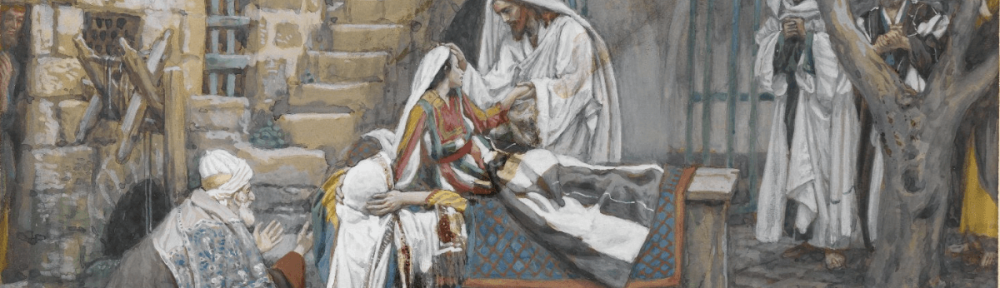
- Raising Jairus’ daughter – “don’t be afraid, only believe” (Mk 5:21-24, 35-43)
- Healing the bleeding woman – her faith saved her (Mk 5:25-34)
These miracles show that Jesus has power over the realms of nature, the demonic, and death. The lectionary for Sunday readings passes over the story of the Gerasene demoniac and moves to the miracles affecting a child and a woman. Our gospel selection includes a miracle within a miracle. They are the final two miracles of the “miracle section” of Mark (4:35-5:43).
As mentioned, in these miracles, Jesus exercises his power over nature, over the demonic army, over sickness, and over death. Another detail which connects several of the readings is the association of Jesus and uncleanliness: the possessed man from the tombs (who is probably a Gentile), the flow of blood from the woman, and being in the presence of death all pull Jesus into the category of ceremonial uncleanness – which is really a way of speaking about holiness.
Holiness – What does it mean to be holy? Is it just about being morally good, or is it more than that? When God made creation, he said it was good—a place where he could live and multiply goodness with humanity. The garden of Eden was the sacred place where God and humans met and flourished together. When humans decided to ignore God’s instructions and live by their own understanding or right and wrong, they became tainted with death and could no longer occupy the sacred space. This decision drove God-space and human-space apart.
God is holy, but he does not want to be separated from his creation; He wants to be close. So to reunite people and creation to himself, he gives Moses instructions to build the tabernacle—an Eden-like space full of cherubim, gold, and paradise-like decor—to invite people back into a holy space with him. The Book of Leviticus uses two expressions for that space: (a) God’s dwelling place and (b) the Tent of Meeting. It was always the first but not always the latter.
God teaches people to follow his instructions for what is clean, pure, and holy. God’s rituals for purity in Leviticus allow for the tabernacle, and the humans who will enter it, to become temporarily clean and unblemished, creating a space where he can meet with humanity again. When the people rebelled and ignored Yahweh’s instructions, even Moses, their representative, was unable to enter the holy tent of meeting. The Book of Leviticus offers a way for humans to atone, seek God’s forgiveness, and repair the rift in the relationship, so that people might be holy and can then approach God. God outlines a system of sacrifice and atonement so that humans can once again enter into God’s presence despite their tendency to choose corruption and human wisdom over the ways of Yahweh.
Image credit: The Daughter of Jairus (La fille de Zäire), 1886-1896 | James Tissot | Brooklyn Museum, | PD-US
Discover more from friarmusings
Subscribe to get the latest posts sent to your email.
 friarmusings