This coming Sunday is the 13th Sunday in Ordinary Time. These miracles have to be understood as within the framework of ceremonial cleanliness. What is clear is that both the woman and the girl were not pure/clean in the Levitical sense because of illness/death. In Jewish thought uncleanness was infectious, a human being might incur it by contact with any unclean person or thing (Lev. 5:3); but the law regarded three forms of uncleanness as serious enough to exclude the infected person from society. These were leprosy, uncleanness caused by bodily discharges, and impurity resulting from contact with the dead (Num. 5:2-4). This is not a topic that is just being introduced in Mark 5. Recall the connection with the ending of Mark 4: the exorcism of the unclean spirits from the man living in the (unclean) tombs into the (unclean) pigs.
Stoffregen writes that “All three characters in Mark 5 transfer their uncleanness to Jesus, and to each Jesus bestows the cleansing wholeness of God. Mark 5 might be called the ‘St. Jude chapter’ (the saint of hopeless causes), for the Gerasene demoniac, the hemorrhaging woman, and Jairus each find hope in Jesus when all human hopes are exhausted.”
Structure. An interesting detail is how the healing of the women with hemorrhages for 12 years is “sandwiched” between the full account of the healing of Jairus’ daughter. Lane [189-90] notes that “The two incidents may have become associated in this way merely because there was an interruption to the journey which proved disastrous for the young girl. But it is possible that Mark saw more in this association: the healing of a woman who has lived with the impingement of death anticipates the healing of a girl who has actually experienced death. The structural device of intercalating one incident within another is paralleled by other instances in which Mark uses the device of anticipation. The detail with which Mark recalls the woman with the hemorrhage indicates that his concern extends beyond the mere passage of time. The healing experienced by the woman is itself a reversal of death and a pledge of the raising of Jairus’ daughter.”
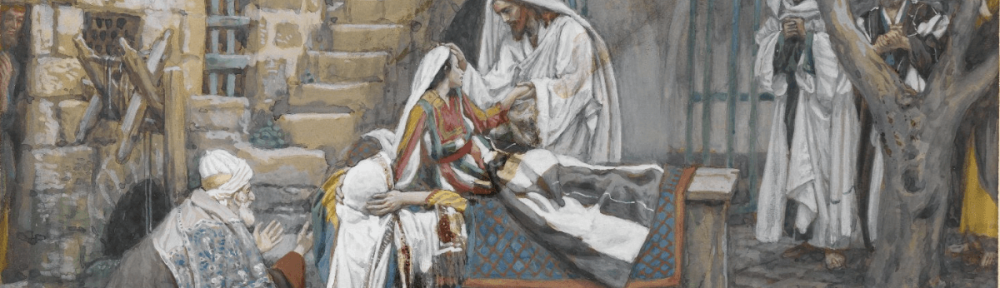
Image credit: The Daughter of Jairus (La fille de Zäire), 1886-1896 | James Tissot | Brooklyn Museum, | PD-US
Discover more from friarmusings
Subscribe to get the latest posts sent to your email.
 friarmusings