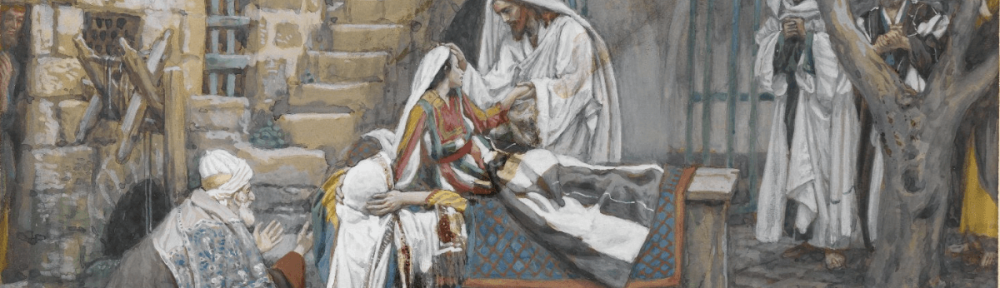
This coming Sunday is the 13th Sunday in Ordinary Time. The account of the healing of the woman and Jairus’ daughter are part of a four-fold miracle narration in which Jesus has shown power over chaotic nature (4:35-41) and destructive demons (5:1-20), and now over debilitating illness and death itself.
In Mark’s Gospel Jesus is closely involved with women nine times. Here in verses 21–43, Mark’s readers enter into two of Jesus’ more moving encounters with women (Jairus’ daughter and the woman with the hemorrhage). Both stories begin with someone seeking out Jesus, the healer. Both stories end in the cure of a person who had been hopelessly sick. Even the way Mark intertwines the two stories shows that Mark wants his readers to hear one important message common to both: “Do not be afraid; just have faith.” (v. 36)! The father of the little girl trusts Jesus even after hearing the report that she is dead (vv. 35–40). He is invited to witness Jesus’ healing touch and word, and then sees his little girl walking around alive (vv. 41–42). The woman shows her trust by touching Jesus (v. 27) and by coming forward in spite of her fear (v. 33). She learns that her faith is rewarded by peace and lasting health (v. 34). Like Jairus and the woman, Christians of every age are urged by Mark to approach Jesus confidently with earnest appeals on behalf of the sick and dying.
Even as he reports Jesus’ miraculous power, Mark preserves the human side of Jesus. For example, the one who has more healing power than the physicians of his day (he cured the woman who had spent all her money and twelve years of time in going to doctors, who failed to help her, v. 26) did not know who touched him (v. 30). Likewise, the one who raises the little girl from her deathbed (v. 41) is also sensitive to her need for something to eat (v. 43). Such details make Mark’s Jesus very approachable; he was perfectly human (he was full of compassion). Mark’s readers can trust him now as those in need did when he walked on this earth. He is sensitive to the needs of those who seek him out.
It is important that Mark’s readers notice the details in this passage that point to the climax of the Gospel. Such hints reveal Mark’s desire to keep his readers moving with Jesus to the place where his journey leads. For example, Peter, James, and John, who witness the raising of the dead girl here, will soon question what “to rise from the dead” means (9:10). Likewise, the fearful, trembling woman with a hemorrhage points to the three women who will leave the empty tomb “seized with trembling and bewilderment,” so afraid that they say nothing to anyone (16:8). There is almost no section of Mark’s Gospel that does not draw his readers to its conclusion. Mark asks his readers, women and men, to stay with Jesus to the end. Even when life’s confusion and tragedies get them down, Mark’s readers are reminded: “Fear is useless. What is needed is trust in God, who brings life, even from death.”
Image credit: The Daughter of Jairus (La fille de Zäire), 1886-1896 | James Tissot | Brooklyn Museum, | PD-US
Discover more from friarmusings
Subscribe to get the latest posts sent to your email.
 friarmusings