This coming Sunday is the 13th Sunday in Ordinary Time. “When Jesus had crossed again (in the boat) to the other side, a large crowd gathered around him…” Jesus is returning from his experience in Gentile territory and the casting out of a demon from a man in the Gerasene district. The transition to our text is simple and stated in one verse. Jesus returned to the western shore of the lake, perhaps to Capernaum and a multitude gathered around him, immediately upon his arrival, so it seems. No indication is given whether the crowd came together as soon as he arrived or after an extended period of time; it is simply the first fact that Mark records, offering a contrast to Jesus’ experience on the eastern shore where the inhabitants urged him to depart.
Without a demarcation of time, the story quickly moves to focus on Jairus, identified as one of the synagogue officials. The word used here could indicate someone of the class of office holder or simply an elder member of the community. In either case, it is clear that Jairus is someone who is well known and respected. It is most likely that he was a lay official responsible for supervision of the building and arranging the religious service.
Jairus stands at the opposite end of the socioeconomic scale from the unnamed woman we will meet in the next section. His status as a synagogue official marks him out as a wealthy and influential member of the community. He would have been accustomed to having others request favors from him. One might expect such a person to send an emissary to ask Jesus to come and heal the little girl. The fact that the father comes and throws himself at Jesus’ feet begging for help shows that he is as desperate as the hemorrhaging woman.
Most commentators do not over-read Jairus’ fall at Jesus’ feet as a sign of worship. In Semitic languages one of the most respectful greetings translates as “I hold your feet.” This is the sense of the word piptō used in the text.
It is not the greeting that is unusual, it is a part of the request. His request that Jesus should come and lay hands in healing upon his daughter reflects a common practice of the day. While this is the first mention of the laying on of hands in Mark, other references occur in 6:5; 7:32; 8:23, 25. What was unusual was his confidence that if Jesus would come, and as a result, his daughter’s life would be saved. Is it an act of faith? An act of desperation by someone whose options are running out? Mark’s narration at this point is too sparse to know more than Jesus went with him, followed by the crowd.
One can easily imagine a large crowd following Jesus, pressing in upon him (v.24). We are now prepared for the account of the woman who touched Jesus in order to be healed.
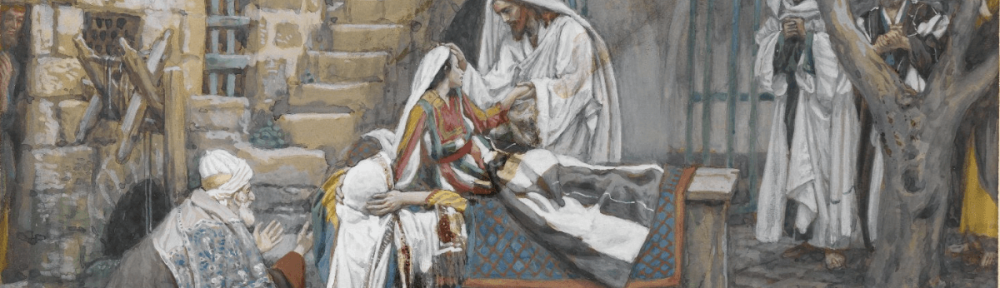
Image credit: The Daughter of Jairus (La fille de Zäire), 1886-1896 | James Tissot | Brooklyn Museum, | PD-US
Discover more from friarmusings
Subscribe to get the latest posts sent to your email.
 friarmusings